A KS2 space topic that survives contact with a real class has three things: one big question per week, one build or test that answers it with the children’s own hands, and a running record of what they found. The national curriculum for England puts Earth and Space in Year 5, but the topic works from Year 1 upwards if you pitch the question to the age. Here is a six-week plan, with the KS1 version alongside.
We deliver space sessions in primary schools every week, and this is the shape our school-day workshops and assemblies use. It is written for a teacher with a normal classroom, a normal budget and a normal Tuesday afternoon.
Where space sits in the curriculum
In England, the statutory space content is Year 5 science, Earth and Space: the movement of the Earth and other planets relative to the Sun, the movement of the Moon relative to the Earth, the Sun, Earth and Moon as approximately spherical bodies, and the Earth’s rotation to explain day and night. Everything else a space topic touches (forces, light, materials, electricity, seasonal change in Year 1) is curriculum too, which is why a space topic is such a useful hook: it lets you teach half the science programme through one story children already care about.
KS1 has no space objective of its own, but seasonal changes (Year 1), everyday materials (Years 1 and 2) and working scientifically all fit comfortably inside a space theme. A Year 1 teacher in one of our partner schools put it well: space is not in the curriculum until Year 5, and her class loves it anyway. In history, KS1 names Neil Armstrong as a significant individual, and our Neil Armstrong activities for KS1 turn that into a Moon landing week.
The six-week plan for KS2
Each week: a question on the board, ten minutes of input, thirty minutes of build or test, ten minutes of recording and debrief. The shape is the same every week on purpose.
Week 1: Where does space begin?
Build a scale model of the atmosphere with a strip of paper: ground at one end, the Kármán line at 100 km, the International Space Station at about 400 km, the Moon far off the end of the corridor. Children discover the “edge” of space is a convention, not a wall. Background reading for you: where does space begin?
Week 2: Why do we have day and night?
The statutory one
A torch, a globe or a ball on a stick, a darkened room. Children take turns being the Sun and the Earth, and mark on a sticky note where it is lunchtime and where it is midnight. Then the harder question: why is it summer here when it is winter in Australia? Tilt the ball. Record with a labelled drawing.
Week 3: How big is the solar system?
Take the class outside with a football for the Sun. At that scale the Earth is a peppercorn about 27 metres away and Neptune is most of a kilometre off. Pace it out. The gasp when they realise the classroom poster is wrong is the learning. Planet fact cards make the recording; why you cannot stand on Uranus is the one that sticks.
Week 4: How does a rocket get off the ground?
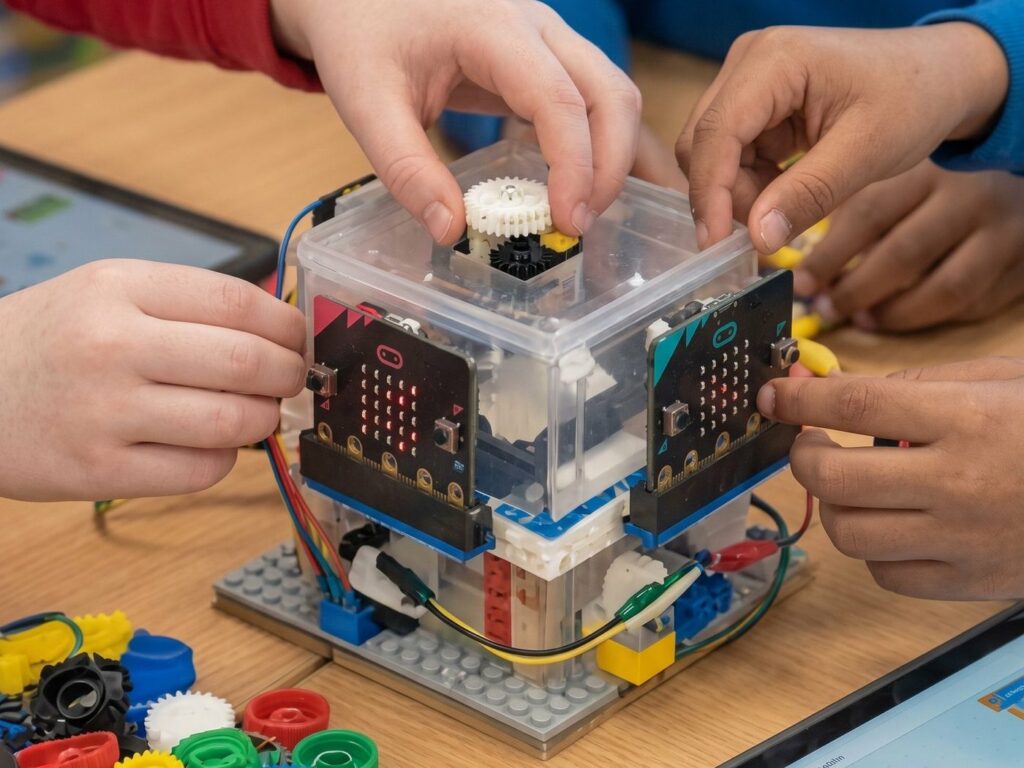
Straw rockets, indoors, with a target on the wall. Each pair builds one, flies it, changes one thing (fins, nose weight, length), flies it again and records both distances in a table. Forces, fair testing and a result they can argue about. How rockets work, explained for a seven year old, is the input.
Week 5: Could we live on Mars?
Design a habitat. Each group gets the constraints (thin air, minus sixty, radiation, no liquid water) and a box of recycling, and has to build a base that keeps a crew alive, then defend their decisions to the class. Materials, insulation and a genuine open question: can humans live on Mars?
Week 6: Can your lander save the egg?
The finale. An egg, a box of materials, a drop from a chair, then from a table. Most first attempts fail. The redesign is the lesson and the class knows it by now. Invite another class, or parents, to watch the drop. End with a debrief: what did you change, and why did it work?
The same six weeks for KS1
Keep the questions, shrink the builds, add story. Week 1 becomes “how high can you throw?” with a paper rocket and a tape measure. Week 2 is the torch and the globe with a teddy as the astronaut. Week 3 is ordering eight painted paper-plate planets on a string. Week 4 is straw rockets with pre-cut fins. Week 5 is “what would you pack for Mars?” with a suitcase and a pile of objects to argue over. Week 6 is the egg drop from a chair only, with the class counting down. Seasonal change, materials and working scientifically are all covered, and nobody has to know the word “statutory”.
Recording without killing it
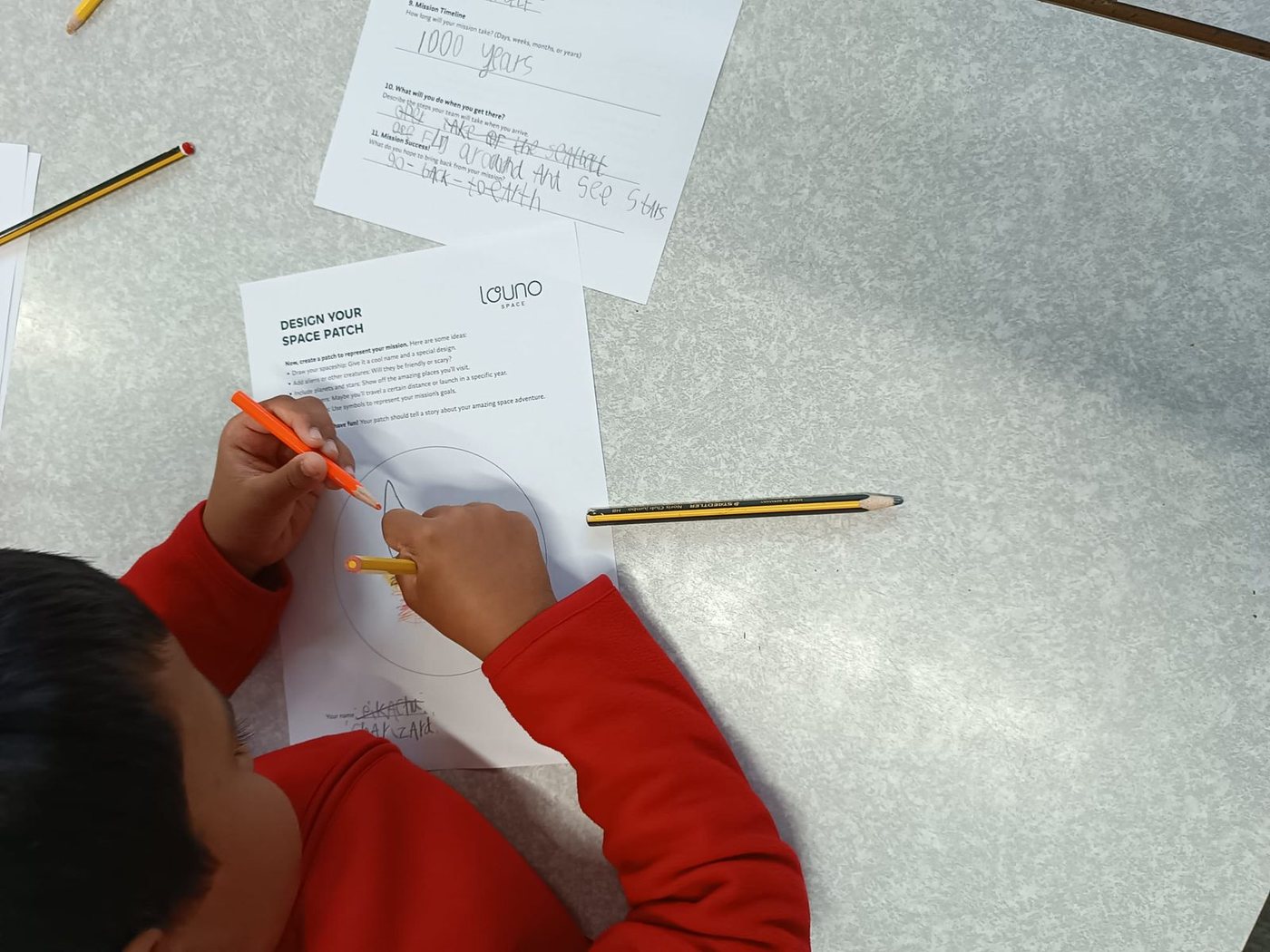
A mission log, one page per week, the same layout each time: the question, a drawing of the build, the result, one sentence on what we would change. It is evidence for the book scrutiny and it is also how children notice they have got better. Photographs of the test (with consent) do more than any worksheet.
The three mistakes that sink a space topic
- Too many facts, too few tests. Children can find the diameter of Jupiter in four seconds. They cannot find out what fins do without flying a rocket.
- No failure allowed. If every lander saves the egg on the first go, the drop was too low. Raise it.
- Pitched to the middle. Write a floor (what every child finishes) and a ceiling (what the fastest pair can push on to) into every week. It takes two extra lines of planning and it is the difference between a class engaged and a class half-lost.
If you want a session delivered for you
Our school-day workshops run the same five-phase structure as the plan above, for a full class, with the kit and the crew included, and the free whole-school assembly is a 45-minute launch for a space topic delivered by a practising spacecraft engineer with real mission hardware. Many schools use the assembly to open the topic and the class takes it from there.
Teaching space in the run-up to Christmas? Our Christmas science activities for KS2 pair ten festive experiments with the same Earth and space objectives, from the Geminid meteor shower to the winter solstice.
Questions teachers ask about the space topic
Which year group does the space topic in KS2?
Year 5, under Earth and Space in the national curriculum for England. Many schools also run a space theme in Year 1 or Year 2 through seasonal change and materials.
How long should a space topic last?
A half term of weekly sessions is enough to cover the statutory content with a build every week and a finale. Longer and the tests start repeating.
What equipment do I need?
A torch, a ball, paper, straws, tape, card, a box of recycling, eggs and a tape measure. Everything in the six-week plan above costs less than a class set of textbooks.

Mirko Viviano
Founder of Louno Space Education CIC. Runs space-themed STEAM clubs, workshops and assemblies in primary schools across the UK.