Neil Armstrong is one of the most popular significant individuals in KS1 history, and the Moon landing gives Year 1 and Year 2 a story with a countdown, a rocket and footprints that are still there today. The best Neil Armstrong activities for KS1 mix the history (what happened, when, and how we know) with something children can make, touch and launch. Here is a five-day plan, the key facts to teach, and activities that need nothing more than what is already in your classroom.
It is written by space engineers who run Moon landing workshops for Year 1 classes.
Where Neil Armstrong sits in the KS1 curriculum
The KS1 history curriculum asks children to learn about the lives of significant individuals who contributed to national and international achievements, and it names Neil Armstrong as an example, paired with Christopher Columbus. That pairing is useful: two explorers, nearly 500 years apart, which gives you a natural compare and contrast lesson.
The Moon landing also links to:
- Science: materials and their properties, and working scientifically
- Geography: the Earth from above, and continents and oceans seen from space
- Design and technology: designing and making a rocket or a lander
The key facts for KS1
Keep it to a handful of facts children can retell:
- The mission was called Apollo 11. It launched from Florida, in the USA, on 16 July 1969.
- Three astronauts went. Neil Armstrong, Buzz Aldrin and Michael Collins.
- The journey took about four days. Michael Collins stayed in orbit around the Moon while the other two landed.
- They landed on 20 July 1969. Their lunar module was called the Eagle.
- Neil Armstrong was the first person to walk on the Moon. Buzz Aldrin followed him a few minutes later.
- They came home safely. They splashed down in the Pacific Ocean on 24 July 1969.
- Their footprints are still there. The Moon has no wind or rain to wash them away.
Armstrong’s first words on the Moon, “That’s one small step for man, one giant leap for mankind”, make a lovely sentence to write, say and act out.
Start with the whole school
The Journey Up is a free 45-minute space assembly that ends its journey on the Moon.
A five-day Neil Armstrong week for Year 1 and Year 2
| Day | Focus | Activity |
|---|---|---|
| Monday | Who was Neil Armstrong? | Story and photos, then a class mind map of what we know |
| Tuesday | The journey | Sequence the mission: launch, journey, landing, first step, home |
| Wednesday | On the Moon | Moon dust craters and footprints |
| Thursday | Make and launch | Straw rockets and a launch range |
| Friday | Then and now | Compare Armstrong with Columbus, and with astronauts today |
Monday: who was Neil Armstrong?
Show photos of Neil Armstrong as a boy, as a pilot and as an astronaut. He loved planes as a child and earned his pilot’s licence before his driving licence. Ask the class what they would need to learn to become an astronaut, and build a mind map together.
Tuesday: sequence the journey
Give pairs five picture cards: the rocket on the launch pad, the spacecraft flying through space, the Eagle landing, the first step and the splashdown in the sea. Children put them in order and retell the story using “first”, “next”, “then” and “finally”. For Year 2, add the dates.
Wednesday: Moon dust craters and footprints
Fill a tray with flour and sprinkle cocoa powder on top. Drop marbles from different heights and look at the craters: the cocoa shows how the “Moon dust” splashes out. Then children press a toy figure or a boot print into the flour. Ask: why would this footprint last for years on the Moon, when footprints on a beach disappear by the next tide?
Thursday: make and launch a rocket
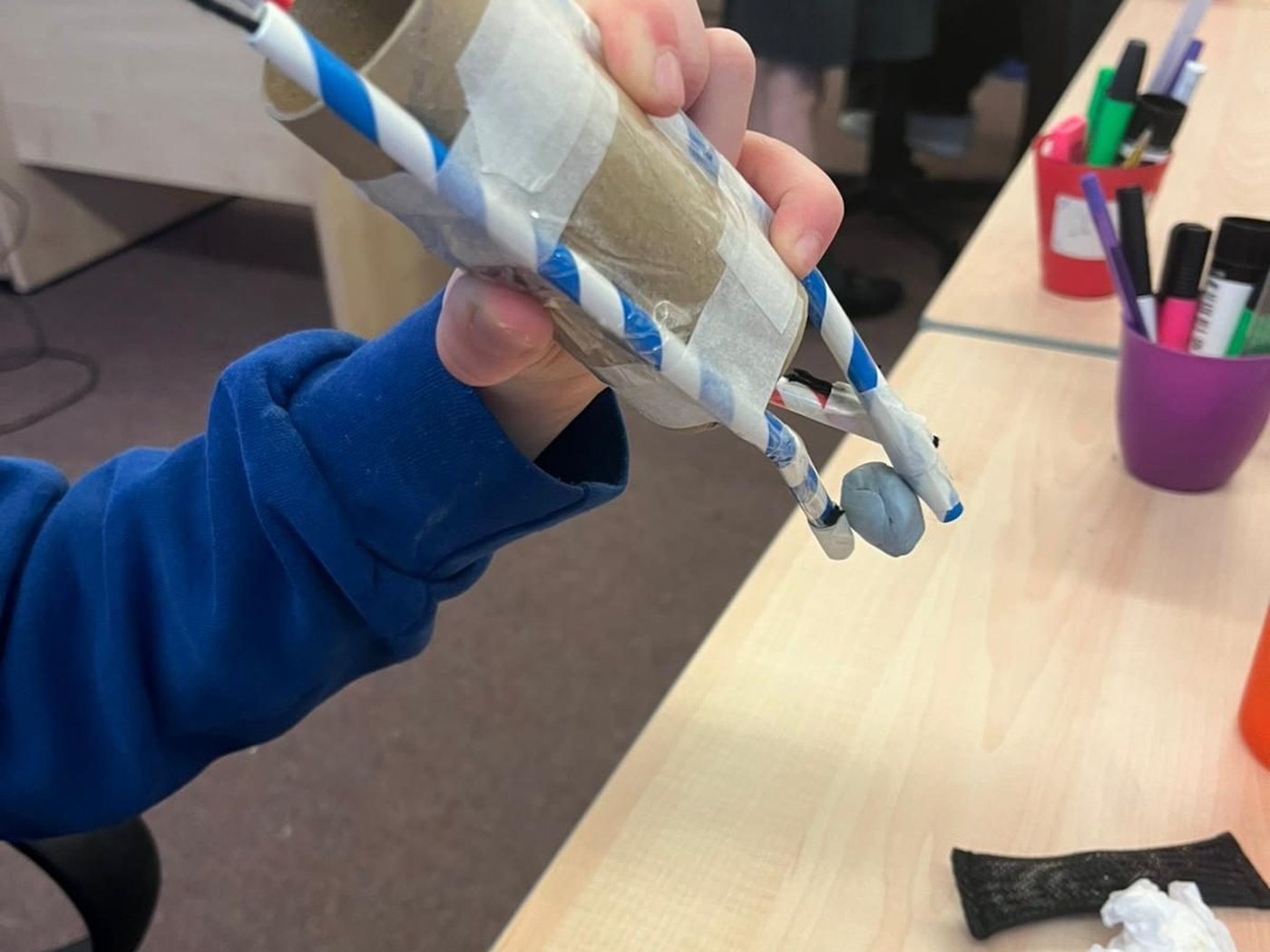
Each child rolls paper round a pencil to make a rocket, adds a nose cone and fins, and launches it by blowing through a straw. Mark distances on the floor with tape. Try one change at a time, such as longer fins or a heavier nose, and see which flies further. Our post on how rockets work explains the science in words a Year 1 child follows.
Friday: then and now
Compare Neil Armstrong with Christopher Columbus. Both were explorers going somewhere new. What did each take with them? How did each find their way? How long did the journey take? Then compare 1969 with today: astronauts now live on the International Space Station for months at a time, and new missions are heading back to the Moon.
Five more Neil Armstrong activities for KS1
- Pack the astronaut’s bag. Children choose what to take to the Moon from a set of picture cards and explain why.
- Mission control role play. A corner with a countdown clock, headsets made of card and a “Houston” sign.
- Write a postcard from the Moon. “Dear Mum, today I walked on the Moon…”
- Moon phases with biscuits. Scrape the cream from sandwich biscuits to show each phase of the Moon.
- Design a mission patch. Every Apollo crew had a patch. Children design one for their own mission.
Adapting for Year 1 and Year 2
- Year 1: focus on the story, sequencing with pictures and the hands-on activities. Use the key facts above.
- Year 2: add dates, a simple timeline across the whole week, and the compare and contrast with Columbus in writing.
Book a Moon landing workshop for your class
If you would like a space engineer to bring the Moon landing to your class, our Year 1 and Year 2 workshop tells the Apollo 11 story as a mission the children join: an astronaut dressed up, a launch across the room, a landing in Moon dust and footprints just like Neil Armstrong’s. Then every child builds and launches their own rocket and takes it home. Each session runs for about 45 minutes per class. Ask about a workshop for your school.
You can also pair it with our free whole-school space assembly, The Journey Up, which ends its journey on the Moon.
Questions teachers ask about Neil Armstrong in KS1
Is Neil Armstrong on the KS1 national curriculum?
Yes. The KS1 history programme of study names Neil Armstrong as an example of a significant individual, alongside Christopher Columbus.
When did Neil Armstrong walk on the Moon?
Apollo 11 landed on the Moon on 20 July 1969. Neil Armstrong stepped onto the surface a few hours later, and in the UK it was the early hours of 21 July.
Who went to the Moon with Neil Armstrong?
Buzz Aldrin, who walked on the Moon with him, and Michael Collins, who flew the command module in orbit around the Moon.
What is a good Neil Armstrong activity for Year 1?
The Moon dust tray. Children make craters by dropping marbles and press footprints into the “dust”, which leads straight into why Armstrong’s footprints are still on the Moon.

Mirko Viviano
Founder of Louno Space Education CIC. Runs space-themed STEAM clubs, workshops and assemblies in primary schools across the UK.
Bring the Moon landing to Year 1
A space engineer, an astronaut costume, Moon dust and a rocket for every child to take home.