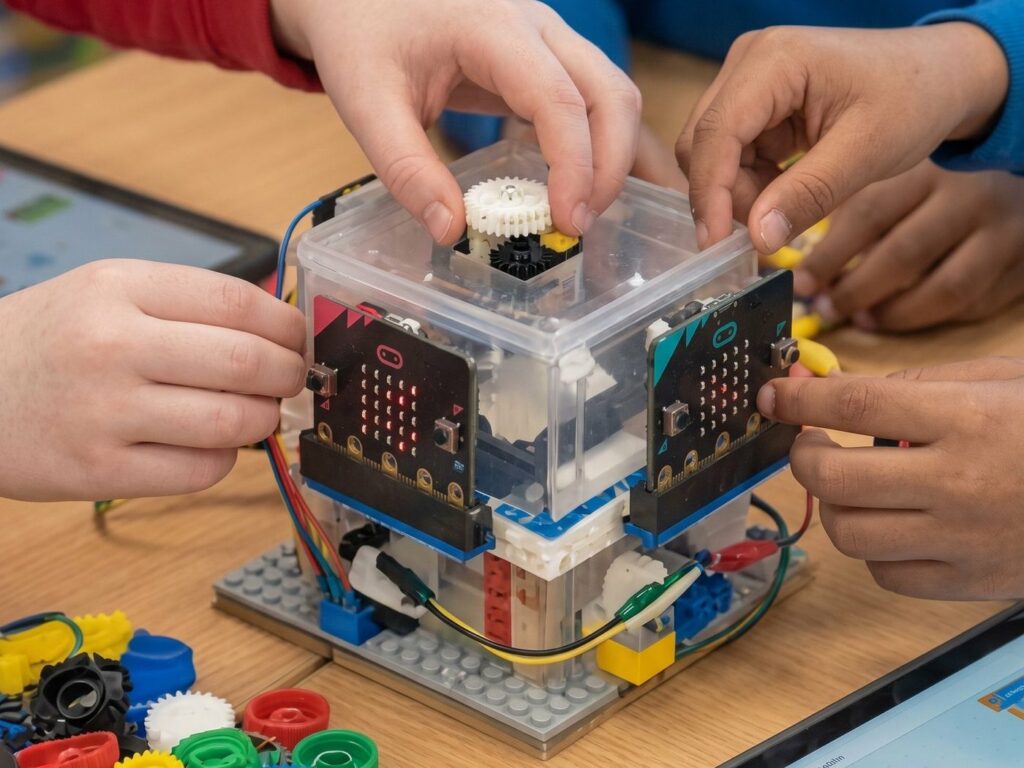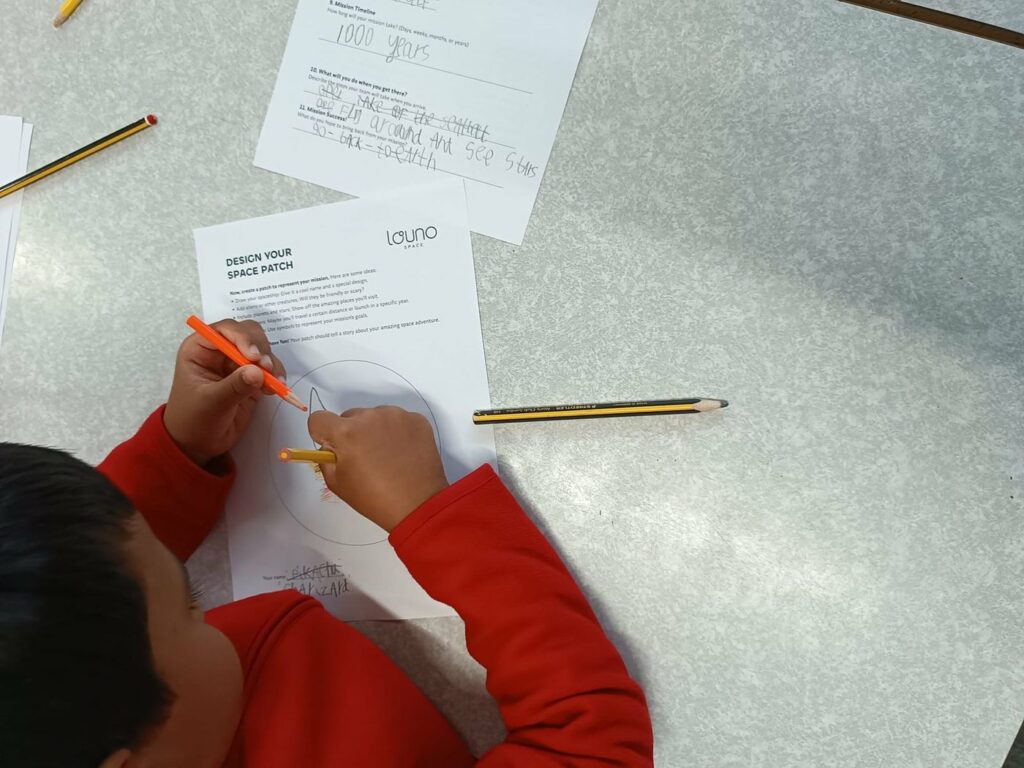
The best STEM assembly ideas for a primary school put one live demonstration at the front of the hall, ask every child to predict what will happen, and then test it in front of them. Here are eight that cover science, technology, engineering and maths, each with the kit, the curriculum link and how to run it in a 20 to 30 minute slot, plus a running order you can lift for the start of the spring term or British Science Week.
They are written by engineers who run space workshops and whole-school assemblies in primary schools, so every idea here has survived a hall of 200 children sitting on the floor.
What makes a STEM assembly work
Three things decide whether a STEM assembly lands. First, a question the whole hall can answer with a hand up or a shout: “Will it break?”, “Which one wins?”, “How many are in the jar?”. Second, a demonstration big enough to see from the back row; if it fits in your palm, put it under a visualiser or swap it for something larger. Third, a moment where the first attempt fails. Children remember the egg that cracked far longer than the one that survived, and a failed test is the clearest way to show what engineers actually do: change one thing and try again.
Keep the talking short. Two minutes of setup, a prediction, the test, one sentence on the science, then on to the next. Pick two or three ideas from the list below for one assembly and save the rest for later in the term.
Eight STEM assembly ideas
1. The egg drop (engineering)
Kit: eggs, a tray, paper, tape, a plastic bag, string, a stepladder. Drop an unprotected egg from the top step into the tray. Then drop one wrapped in a paper cone, and one hanging from a carrier-bag parachute. Ask the hall to vote on which survives before each drop. The parachute slows the fall because of air resistance, which links straight to Year 5 forces. Finish by setting the challenge for classes to design their own lander that week.
2. The human robot (technology)
Kit: a volunteer adult, a chair, a cup. The adult is a robot who follows instructions exactly as given. Children call out how to get the robot to sit on the chair and pick up the cup. “Walk forward” sends the robot walking into the wall, because nobody said how many steps. Within a minute the hall is giving precise, ordered instructions, which is what an algorithm is. It matches the KS1 computing aim of understanding algorithms as precise and unambiguous instructions, and KS2 children enjoy spotting the bug.
3. The balloon rocket race (science)
Kit: two long balloons, two drinking straws, fishing line stretched across the hall, tape. Thread a straw on each line, tape a blown-up balloon to each straw, and release. Air rushes out of the back and the balloon shoots forward, the same push that lifts a real rocket. Race a fully inflated balloon against a half-inflated one and ask the hall to predict the winner. Our guide to how rockets work for kids has the explanation in words a seven-year-old will follow.
4. The paper bridge (engineering)
Kit: two piles of books, sheets of A4 paper, a pot of coins. Lay a flat sheet across the gap and add coins until it sags. Then fold a second sheet into a zigzag, or roll it into tubes, and try again. The same paper holds many more coins once its shape changes. This is the KS2 design and technology idea of strengthening and stiffening structures, and it gives children a reason to look at real bridges on the way home.
5. The estimation jar (maths)
Kit: a large clear jar of dried pasta or counters. Ask each class for one agreed guess, written on a whiteboard. Then count a small cup’s worth together and ask how many cups fill the jar. Guesses tighten fast once children have a reference amount, which is the whole point of estimation. Reveal the real number at the end of the week and give the closest class the job of filling the next jar.
6. Shadow puppets (science)
Kit: a bright torch or the projector, a card puppet, a white wall or screen. Move the puppet closer to the light and the shadow grows; move it away and it shrinks. Ask the hall to predict which way to move it to make the shadow fill the screen. It covers the Year 3 light objective of finding patterns in the way the size of shadows changes, and the youngest children will happily shout directions.
7. The mystery circuit (science)
Kit: a battery, wires with crocodile clips, a bulb or buzzer, and a tray of objects: a spoon, a pencil, foil, a rubber, a coin. Put each object in the gap in the circuit and ask the hall whether the bulb will light. The surprise is usually the pencil, because the graphite in the lead conducts when you clip onto both ends of the core. It links to Year 4 electricity on conductors and insulators, and Year 6 can push it further with a dimmer made from the pencil lead.
8. What’s my job? (careers)
Kit: a guest, or three short clues on slides. A parent, governor or local employee who works in a STEM job gives three clues about their day, and the hall guesses the job. Engineers, nurses, coders, farmers and pilots all use STEM, and seeing a real person who does the job is what makes it feel possible. If you have no guest, invite one by video for five minutes. Our space engineer’s account of the job gives you a ready-made set of clues.

Follow the assembly with a workshop
A space engineer runs a hands-on STEM day for your class, with every piece of kit included.
The eight ideas at a glance
| Idea | STEM area | Curriculum link | Best for | Setup |
|---|---|---|---|---|
| Egg drop | Engineering | Year 5 forces (air resistance) | KS2 | 10 minutes |
| Human robot | Technology | KS1 and KS2 computing (algorithms) | Whole school | None |
| Balloon rocket race | Science | Year 3 and Year 5 forces | Whole school | 10 minutes |
| Paper bridge | Engineering | KS2 design and technology (structures) | Whole school | 5 minutes |
| Estimation jar | Maths | Estimation and place value | Whole school | 5 minutes |
| Shadow puppets | Science | Year 3 light | KS1 and lower KS2 | 5 minutes |
| Mystery circuit | Science | Year 4 and Year 6 electricity | KS2 | 10 minutes |
| What’s my job? | Careers | Enrichment and careers awareness | Whole school | A guest or three slides |
A 20-minute running order you can use
- 0 to 2 minutes: the big question on the screen: “What do scientists, engineers and mathematicians actually do?”
- 2 to 8 minutes: the human robot. Fast, funny and it needs no kit, so it settles the hall.
- 8 to 15 minutes: the egg drop, with a vote before each drop and a cheer or a groan after.
- 15 to 18 minutes: the estimation jar, one guess per class, answer revealed on Friday.
- 18 to 20 minutes: the week’s challenge: every class designs an egg lander, and the best three are dropped in next week’s assembly.
If your slot is 25 or 30 minutes, add the paper bridge after the egg drop. If it is 15, drop the estimation jar and announce the challenge straight after the egg.
Adapting a STEM assembly for KS1 and KS2
For Reception and KS1, keep each demonstration under five minutes and make every prediction a choice between two: up or down, break or survive, light or no light. Let children answer with their whole body, standing for one answer and sitting for the other. For KS2, ask for a reason with every prediction and let a Year 6 child run one of the tests. In a mixed hall, pitch the question at KS1 and the explanation at KS2: the younger children enjoy the bang, the older ones enjoy knowing why.
When to run a STEM assembly
The first week of the spring term is a strong slot: children come back curious, and a challenge set in assembly fills the first weeks of science lessons. British Science Week every March is the other natural moment, and many schools run a STEM assembly to launch it. A STEM assembly also gives you evidence for enrichment: the DfE Enrichment Framework guide explains how activities like this count, and our piece on improving STEM provision in a primary school shows how an assembly can start a longer plan, such as a science club.
If space is your theme this term, our space assembly ideas for primary schools follow the same format with ten space-specific demonstrations.
Book a free STEM assembly from a space engineer
If you would rather someone else ran it, our whole-school assembly, The Journey Up, is free for primary schools. It lasts 45 minutes, covers science, technology, engineering, arts and maths through the story of a rocket climbing into space, and is delivered by a practising spacecraft engineer with live demonstrations and all equipment included, for every year group from Reception to Year 6. We have local teams in Hampshire, London, Essex and York. Book a free assembly for your school, or see our hands-on space workshops for a class-sized follow-up.
Questions teachers ask about STEM assemblies
How long should a primary school STEM assembly be?
Twenty to thirty minutes suits most primary halls: long enough for two or three demonstrations with predictions, short enough to hold Reception. A visiting assembly with several demonstrations and a story can run to 45 minutes, which is the length of our free assembly.
What is the difference between a STEM and a STEAM assembly?
STEAM adds the arts to science, technology, engineering and maths. In an assembly that usually means a design element, such as decorating the egg lander or drawing the bridge before building it, or a story that carries the science along.
Do I need special equipment for a STEM assembly?
Every idea above uses kit most schools already have: eggs, paper, balloons, string, a torch, a battery and some wires. The only extra is a visualiser or camera on the projector, so the back row can see the small demonstrations.
Can a STEM assembly count towards enrichment?
Yes. An assembly is a whole-school enrichment moment, and it is strongest when it leads somewhere: a class challenge, a visit from a STEM professional, or an after-school club that keeps the interest going.

Mirko Viviano
Founder of Louno Space Education CIC. Runs space-themed STEAM clubs, workshops and assemblies in primary schools across the UK.
Let a space engineer run your next assembly
Free for primary schools, all equipment included, delivered by a practising spacecraft engineer.