Where does space begin? The usual answer is 100 kilometres up, at a line named after an engineer called Theodore von Kármán. The honest answer is that the air gets thinner and thinner and never quite stops, so the edge of space is a line people agreed on rather than one you could see. Both answers are worth giving a child, because the gap between them is where the interesting science lives.
This is the explanation we use in assemblies, written for a seven year old to follow and a teacher to repeat, with a strip of paper at the end that makes the whole thing visible.
The short answer: 100 kilometres
Most of the world uses the Kármán line, 100 km above sea level, as the boundary of space. Above it, you count as an astronaut. The number comes from von Kármán’s reasoning in the 1950s: somewhere around that height the air is so thin that wings stop working, because to get any lift you would have to fly so fast you would be in orbit anyway. Above that line you are not flying. You are falling around the Earth.
The United States uses 50 miles, about 80 km, for its astronaut wings. Two official answers to the same question is a useful thing for a child to notice. It means somebody chose.
The long answer: it fades out
The atmosphere does not have a top. It gets thinner the higher you go, the way fog does at the edge of a field. Airliners fly at about 10 to 12 km, where the air is already too thin to breathe. The aurora glows between roughly 100 and 300 km, which means there is still air up there, just very little. The International Space Station orbits at about 400 km and still feels a faint drag from the wisps of atmosphere that reach that high; it has to be nudged back up every few weeks or it would slowly sink. There are traces of air hundreds of kilometres beyond that.
So where does space begin? Wherever you draw the line. The line is useful, the way the line between a stream and a river is useful, and it is still a line somebody drew.

Make it visible: the strip of paper
Take a strip of paper a metre long and call one end the ground. One millimetre per kilometre. Mark the top of Everest at 9 mm. Mark an airliner at 11 mm. Mark the Kármán line at 10 cm. Mark the Space Station at 40 cm. The Moon, at the same scale, is 384 metres away, which is most of the way down the street, so send a child to stand where it would be.
Two things land when children do this. First, how thin the layer we live in is: everything that has ever breathed lives in the first centimetre of the strip. Second, how close space is. A hundred kilometres is less than the drive to the seaside. It is not far up. It is just very hard to get to, because you have to go sideways at 28,000 km/h to stay there.
Why it is hard to stay up there
This is the question that usually follows, and it is a good one. If space is only 100 km away, why is it so hard to reach? Because going up is the easy part. Stopping yourself falling straight back down means going sideways fast enough to keep missing the Earth as you fall, and that speed, not the height, is what a rocket spends almost all of its fuel on. A balloon can get a third of the way to the Kármán line; nothing but a rocket can make the turn.
Three ways to explore it with a class or at home
- The strip of paper, above. Fifteen minutes, and it replaces every diagram you own.
- Spot the Space Station. Its passes are published online for free. Just after sunset it crosses the sky as a bright, steady light in a few minutes. It is 400 km up, four times the height of the line, and you can see it from the garden.
- Argue about it. Put two numbers on the board, 80 km and 100 km, and ask the class which is right and why anyone gets to decide. Then tell them both are official. The best science conversations we have had with nine year olds started there.
Where this question goes next
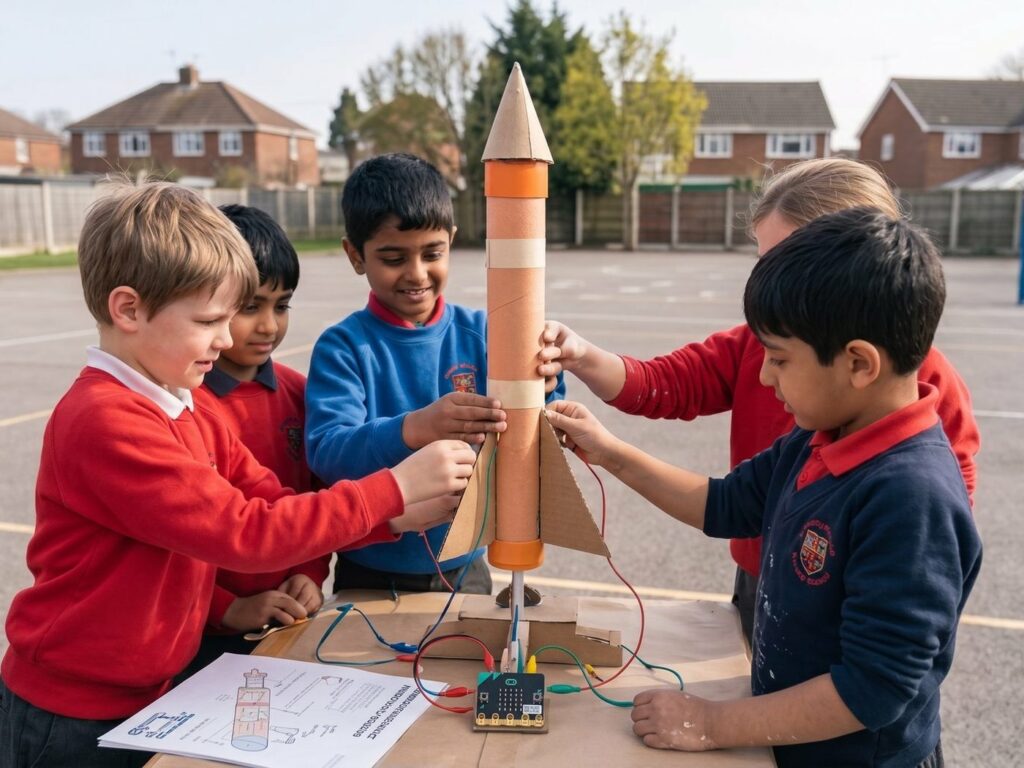
Once a child knows where space begins, the next question is usually how you get there, and the one after that is whether you could stay somewhere once you arrived. In the Space Club those questions become missions: a rocket to build and launch, a lander to test, a habitat to defend. And the first time most children hear this explanation is in our free whole-school assembly, from an engineer who has sent hardware across that line.

Mirko Viviano
Founder of Louno Space Education CIC. Runs space-themed STEAM clubs, workshops and assemblies in primary schools across the UK.