How do rockets work? A rocket throws stuff out of the bottom as fast as it can, and the stuff pushes back. That push is what lifts it. Everything else about a rocket, the fuel, the shape, the stages that fall off, exists to throw more stuff faster or to waste less of the push. Here is the seven-year-old version, and then the nine-year-old version for when the first one runs out.
This is the explanation we use at parties, camps and clubs, written by engineers who build spacecraft for a living and have had to answer it in a school hall with two hundred children watching. It comes with things to try, because a rocket is much easier to understand with one in your hand.
The seven-year-old version: push and push back
Stand on a skateboard and throw a heavy ball forwards. You roll backwards. You pushed the ball one way; the ball pushed you the other. A rocket does the same thing, except instead of one ball it throws out a huge amount of very hot gas, very fast, and it keeps throwing for minutes. Every bit of gas that goes down pushes the rocket up a tiny bit, and there is so much gas going so fast that the tiny bits add up to enough to lift something the size of a building.
That is it. Push stuff out one way, get pushed the other way. It is why a balloon flies round the room when you let go of it, why a garden hose kicks when you turn it on, and why a water rocket jumps off its stand.
Try it: three rockets you already own
- A balloon. Blow it up, hold the neck, let go. Air out the back, balloon forwards. Tape it to a straw on a string across the room and it flies in a straight line: that is a rocket with a guide rail.
- A straw rocket. A paper tube on a drinking straw, and your breath is the gas. Add fins and watch it stop tumbling.
- A water rocket. Air pumped into a bottle pushes the water out of the neck; the water pushes the bottle up. Our bottle rocket guide has the build and the safety rules. It goes higher than the house.

The nine-year-old version: why it is mostly fuel
Here is the surprising part. A rocket on the launch pad is almost all fuel. For a big rocket, roughly nine-tenths of what you see is propellant and only a sliver at the top is the bit that goes to space. The reason is the push-back rule again: to lift something heavy, you have to throw a lot of stuff out of the bottom, and all that stuff has to be carried up with you until it is used. So you need fuel to lift the fuel, which needs more fuel. Engineers call this the tyranny of the rocket equation, and it is why rockets are so big and payloads are so small.
It is also why rockets come in stages. Once the first tank is empty it is just dead weight, so the rocket drops it and a smaller, lighter rocket carries on. The bits falling away in a launch video are not breaking; they are being thrown away on purpose.
Why rockets work in space when jets do not
A jet engine on an aeroplane sucks in air, burns fuel in it and throws the hot air out of the back. No air, no jet. A rocket carries its own oxygen in a tank next to the fuel, so it can burn in space where there is nothing to breathe. That is the whole difference, and it is the reason your balloon would still fly in space (there is no air to push against, and it does not need any: it is pushing against the air it throws out, not the air around it).
Children often think a rocket pushes against the ground or the air to go up. It does not. Ask them: what does the balloon push against? The answer is the air that was inside it. Nothing outside is needed.
Why the shape matters
Three things you can test with a straw rocket in the living room.
- Fins at the back keep the rocket pointing the way it is going. A rocket without fins tumbles. Try both.
- A pointed nose slips through the air with less drag. A flat-topped rocket flies, but not as far.
- Weight near the front makes it fly straighter, which is why a blob of modelling clay in the nose cone helps. Too much and it nose-dives; that is a test too.
What happens at the top
Going up is only half the job. To stay in space a rocket has to go sideways, very fast, so that as it falls towards the Earth it keeps missing. That is what an orbit is: falling and missing. The International Space Station is doing it right now at about 28,000 kilometres an hour, which is why it crosses the whole sky in a few minutes when you spot it after sunset. And that is a different question, which we will answer in another article when a child at a camp asks it, which will be soon.
The one-sentence version to keep
A rocket throws gas out of the bottom, the gas pushes the rocket up, and it carries its own oxygen so it can keep doing that in space. Everything else is detail, and the detail is the fun part.
Where children get to build one
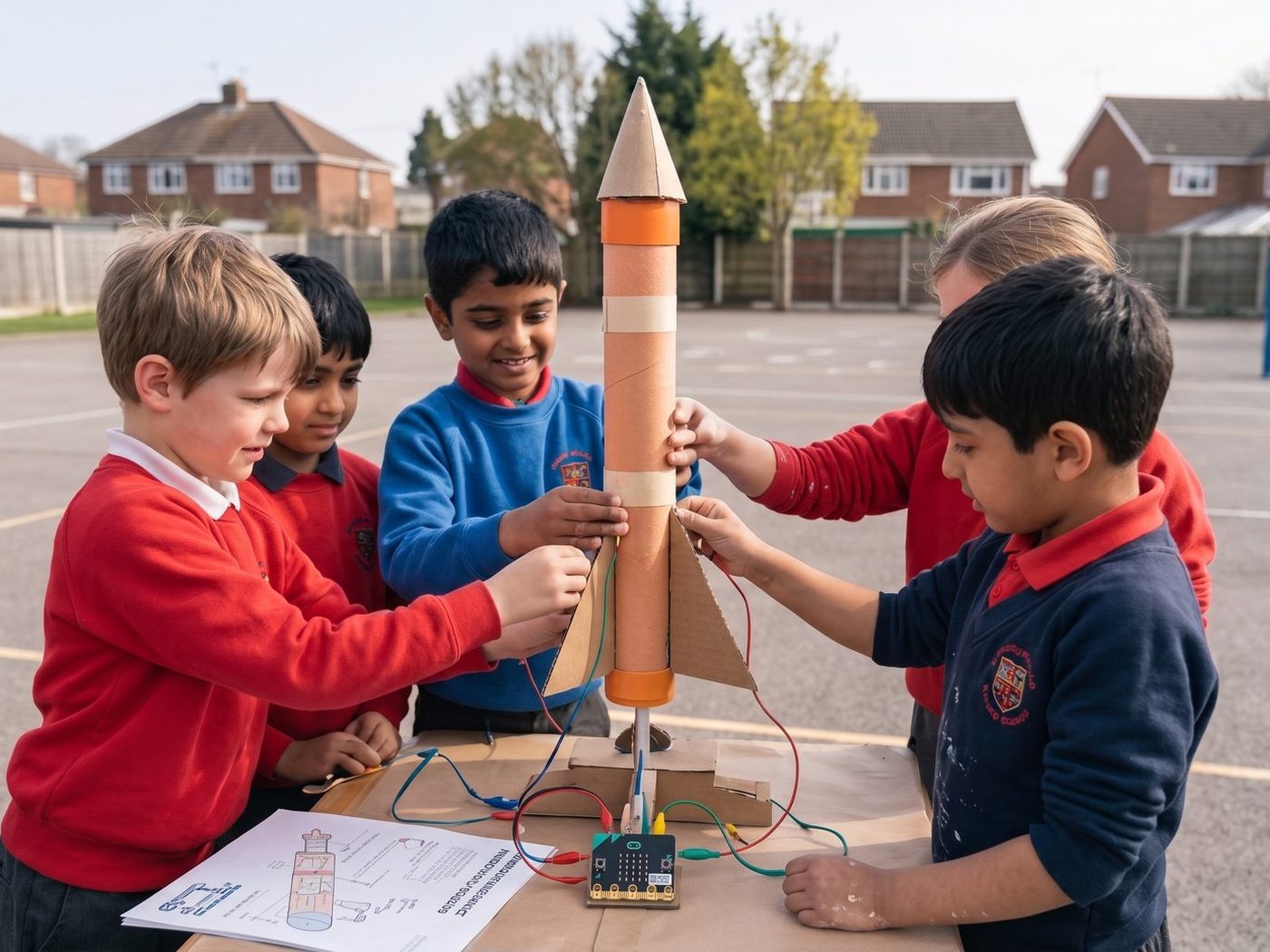
Rocketry is the most-requested theme at our space birthday parties: every child builds a rocket, and a real space engineer runs the launch. At a holiday camp the crew has five days to build, test, redesign and fly, and at the weekly Space Club rockets are one mission in a library of more than a hundred. The explanation above is the one they hear, just before the countdown.
Questions children ask about rockets
Does a rocket push against the air?
No. It pushes against the gas it throws out of its own engine. That is why it works in space, where there is no air at all.
Why are rockets so big?
Because almost all of a rocket is fuel, and the fuel has to lift itself as well as the small part at the top that goes to space.
Why do bits fall off a rocket?
On purpose. Empty fuel tanks are dead weight, so the rocket drops them and a lighter rocket carries on. Those are the stages.

Mirko Viviano
Founder of Louno Space Education CIC. Runs space-themed STEAM clubs, workshops and assemblies in primary schools across the UK.