Twenty space activities for kids at home, each with the kit, the time, and the one bit of real science underneath. They are pitched at KS2 (seven to eleven), with a note where a younger sibling can join in. Nothing needs a specialist shop; most of it is already in the kitchen drawer. Pick one for a wet afternoon, or run one a day over a half term.
These are the activities we send home from our clubs and camps, and the ones parents tell us their children ask to do again. Each one follows the same rule we use in sessions: make something, test it, change one thing, test it again.
Build and launch
1. Straw rockets
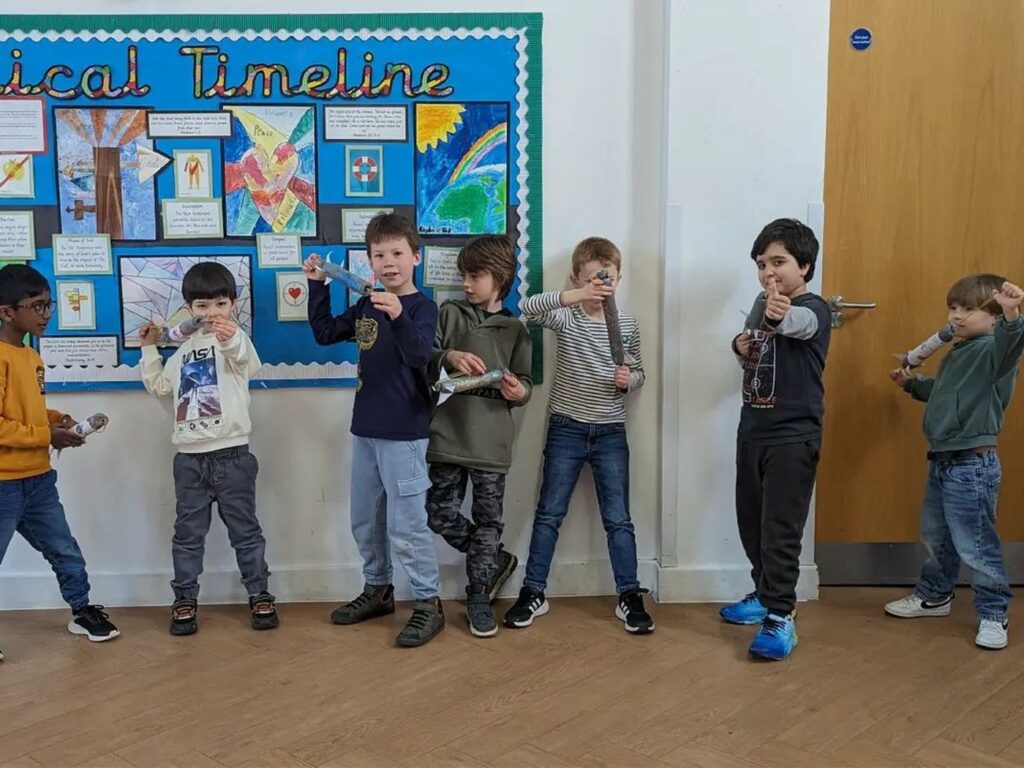
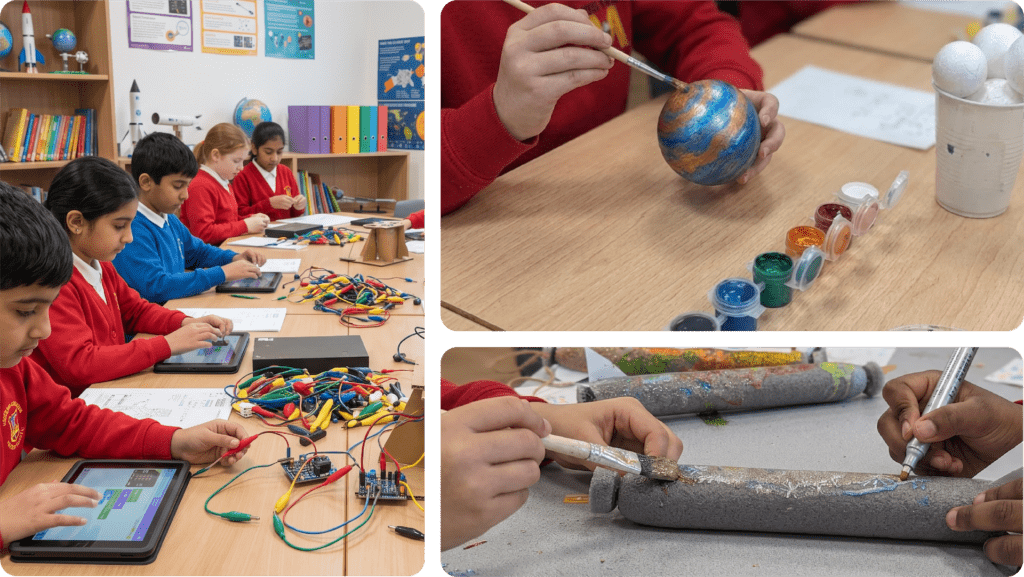
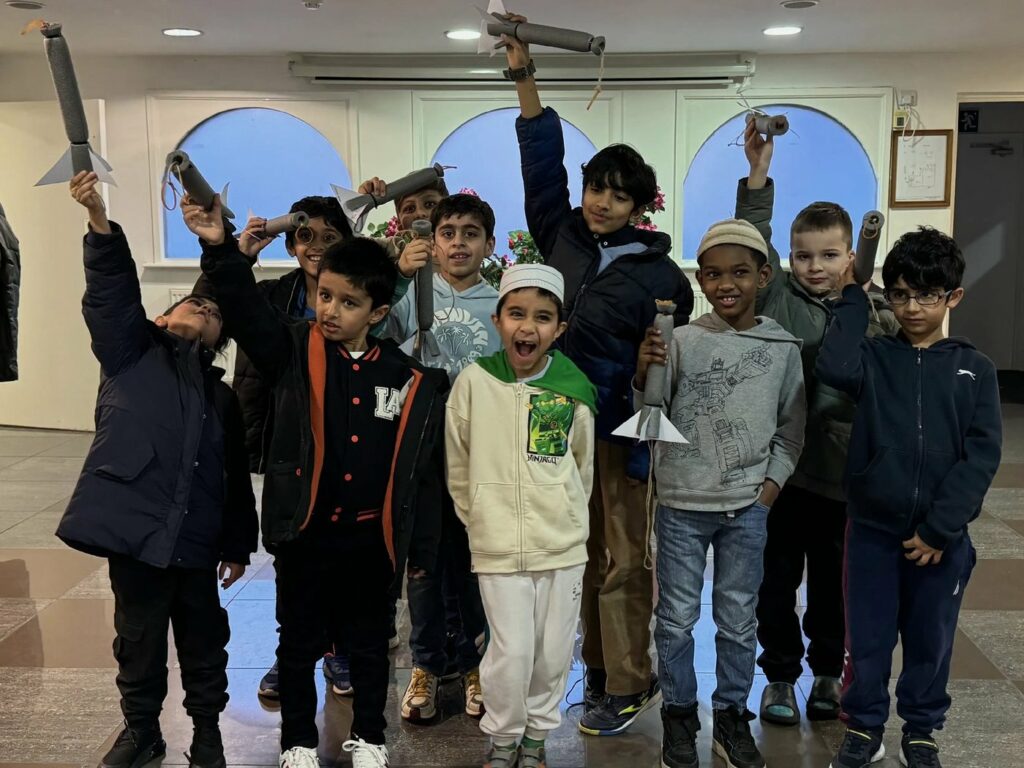
Kit: paper, tape, card, a pencil, drinking straws. Time: 20 minutes. Roll paper around a pencil, seal one end, add a cone and fins, fire it from a straw. Measure, change the fins, fire again. The science: fins keep a rocket pointing the way it is going.
2. Balloon rocket on a string
Kit: a balloon, a straw, string, tape. Time: 15 minutes. Thread the string through the straw, tie it across the room, tape an inflated balloon to the straw and let go. Try a long thin balloon against a round one. The science: air rushing out one way pushes the balloon the other way, which is exactly how a rocket engine works. Fine for a four year old with help.
3. Bottle rocket (garden only)
Kit: a two-litre fizzy-drink bottle, a cork, a bicycle pump with a ball needle, a stand. Time: 40 minutes. The big one. Read our bottle rocket guide first, because the safety rules are the activity. The science: pressure, mass and the same push-back rule as the balloon, scaled up.
4. Egg lander drop
Kit: an egg, a box of recycling, tape, a chair. Time: 45 minutes. Build a lander that protects the egg from a chair-height drop. It will probably fail. Redesign, drop again, then raise the drop. The science: slowing the landing down spreads the force over time, which is what every real lander does with legs, airbags or parachutes.
5. Parachute for a toy astronaut
Kit: a plastic bag, string, a small toy, a stopwatch. Time: 30 minutes. Make three parachutes of different sizes and time the drop from the landing. The science: a bigger canopy catches more air and slows the fall; too big and it swings.
Planets, Moon and Sun
6. Solar system on a toilet roll
Kit: a roll of toilet paper, a pen. Time: 20 minutes. Unroll it down the hallway. The Sun is the first sheet; Mercury is on sheet 1, Earth on sheet 2 and a half, Jupiter on sheet 13, Neptune on sheet 76. The science: the solar system is mostly empty, and every poster lies about it.
7. Moon craters in flour
Kit: a tray, flour, a dusting of cocoa, marbles and stones, a ruler. Time: 30 minutes. Drop a marble from knee height, then from shoulder height, and measure the crater. Try a heavier stone. The science: crater size depends on speed and mass, which is how scientists read the Moon’s history from its surface. Messy, and brilliant for five year olds.
8. Day and night with a torch
Kit: a torch, a ball or an orange, a sticker for your house. Time: 15 minutes, in a dark room. Spin the ball slowly in the torch beam and watch your sticker go from lunchtime to midnight. Tilt the ball for the seasons. The science: the Year 5 Earth and Space topic, in your hands.
9. Moon phases with a biscuit
Kit: eight cream-filled biscuits. Time: 15 minutes. Twist each one open and scrape the cream into the eight phases, from new moon to full and back. Eat the evidence. The science: the Moon does not change shape; we see different amounts of its lit side.
10. Sundial on the patio
Kit: a stick, chalk, a sunny day. Time: one minute every hour. Mark the shadow’s tip each hour and join the dots at tea time. The science: the Earth turns, the shadow moves, and a sundial is just a very old clock.

Engineering challenges
11. Spaghetti launch tower
Kit: dry spaghetti, marshmallows. Time: 20 minutes. The tallest tower that holds a paper rocket for ten seconds. Triangles win. The science: why engineers love triangles.
12. Design a Mars habitat
Kit: a shoebox, recycling, foil, tape. Time: an hour. The brief: keep a crew alive with thin air, minus sixty degrees and radiation. Then the child explains every decision to you. The science: insulation, shielding and the real constraints in can humans live on Mars?
13. Satellite with a budget
Kit: a small box, a pile of “parts” (bottle tops, lolly sticks, foil) each with a made-up mass and cost on a sticker, a budget. Time: 40 minutes. Build a satellite that does a job (take photos of Earth, say) without going over the mass or the money. The science: systems engineering for nine year olds. The budget is the lesson, and it is the mission we run with real nine year olds.
14. Spacesuit glove test
Kit: oven gloves or thick gardening gloves, a jar, a shoelace, a coin. Time: 10 minutes. Open the jar, tie the lace, pick up the coin. Time it bare-handed, then gloved. The science: real spacesuit gloves are pressurised and stiff, and astronauts train for months to do simple jobs in them.
15. Robot arm from cardboard
Kit: cardboard, string, straws, a paper cup. Time: 45 minutes. A grabber that can pick up a cup from across the table, pulled by strings. The science: how the robotic arms on the space station and on Mars rovers move without a hand inside them.
Observe and record
16. Spot the space station
Kit: a clear evening and a free pass-prediction website. Time: five minutes outside. The International Space Station crosses the sky as a bright, steady, silent light, and the times are published. The science: it is 400 km up and lit by the Sun, which is why you see it just after sunset.
17. Moon diary
Kit: a notebook, a pencil, a window. Time: two minutes a night for a month. Draw the Moon every clear night and watch the shape cycle. The science: the phases, observed rather than told, and a habit of recording.
18. Find the Plough and Polaris
Kit: a dark-ish garden, a clear night. Time: 10 minutes. Find the saucepan shape, follow the two stars at the end of the pan upwards to the North Star. The science: Polaris sits almost above the Earth’s axis, so it stays still while everything else turns, which is why sailors steered by it.
Think like a scientist
19. Heavy and light, dropped together
Kit: a tennis ball and a table-tennis ball. Time: five minutes. Predict which lands first. Drop them together. Do it three times. The science: gravity pulls everything down at the same rate; air resistance is what makes a feather different, and on the Moon, where there is no air, a hammer and a feather landed together.
20. Where does space begin? Argue about it
Kit: a strip of paper, a ruler. Time: 20 minutes. Mark the ground at one end, an aeroplane at 1 cm, the Kármán line at 10 cm, the space station at 40 cm. Then ask where space “starts” and why anyone gets to decide. The science: the atmosphere thins gradually, and the edge is a line people agreed on. Our explainer where does space begin? has the detail.
A week of it, if you want one
Our holiday space camps are five days of exactly this, in a crew of up to sixteen, with each day building on the last and a Friday showcase where children present what they built, what failed and what they would change. And if the activities above have produced a child who will not stop asking questions, the Space Club runs a different mission every week in school.

Mirko Viviano
Founder of Louno Space Education CIC. Runs space-themed STEAM clubs, workshops and assemblies in primary schools across the UK.