What a payload systems engineer actually does on an ordinary working day
People hear “space engineer” and picture a rocket launch. Most of my working days look nothing like that. I’m a payload systems engineer, and the job is really about making sure a piece of hardware will still work perfectly after it has been shaken, frozen, baked and flung into orbit, with nobody there to fix it if something goes wrong.
An ordinary day might start with a design review: a few of us around a screen, picking apart a schematic line by line, asking what happens if this connector fails, or if this component runs five degrees hotter than we planned. Then there’s testing, hours of it, where we put hardware through vibration tables and thermal chambers designed to recreate the worst few minutes of a launch and the harshest swings of space. There’s a lot of writing too: test reports, requirement documents, emails to colleagues in other countries who are building the part that has to fit against yours to the millimetre. It’s slower and more collaborative than the public picture of space engineering, and that’s exactly why it works. Spacecraft don’t get a second attempt, so the excitement, for me, is in the discipline itself.
The Moon hardware work, and why it mattered
The part of the job I’m proudest of is having worked on hardware for a payload bound for the Moon, hardware that is part of a wider European effort to understand and explore it. I can’t go into the specifics of the mission here, but I can tell you what it means to work on something like that.
Every component you touch becomes something you can never quite take for granted again. You sign off a design knowing that once it leaves the ground, it leaves your hands completely. There’s no site visit, no spare part sent out by courier, no retry next week. That responsibility changes how you work. It makes you check things twice, then a third time, then ask someone else to check them too. It mattered because it was a small, specific contribution to humanity reaching somewhere it hadn’t properly been before, and because getting it right meant years of other people’s work, all the way down to a careful student in a lab, arriving safely at its destination.

Engineering skills, every week
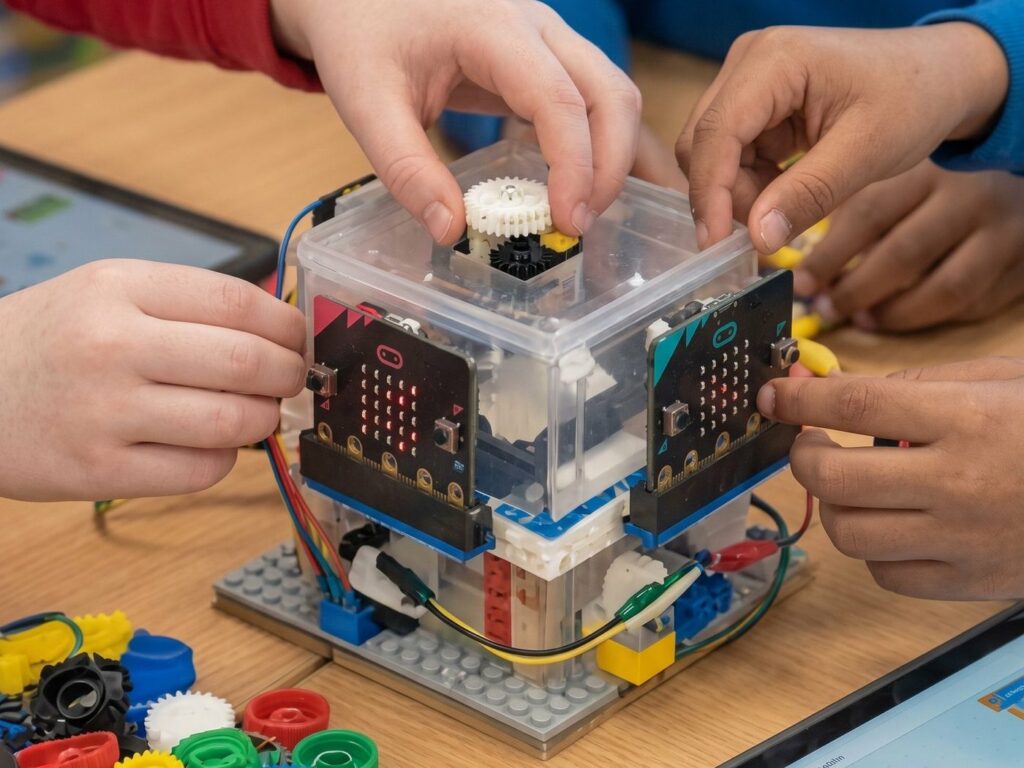
Space Club gives KS2 children a new hands-on engineering mission after school each week.
Something that went wrong, and how the team solved it
Nothing this complicated goes smoothly all the way through, and the moment that taught me the most was when a piece of hardware failed a test it should have passed. We’d built it, qualified it on paper, and then watched it behave differently under real conditions than the models had predicted. In the room, that’s a genuinely bad feeling: a milestone slipping, a schedule under pressure, and a nagging question about whether the design itself was wrong.
What got us through wasn’t one clever insight from one clever person. It was systematic, slightly unglamorous teamwork: going back through the test data properly instead of guessing, bringing in people from other disciplines who could see angles we’d missed, and being honest with each other and with the wider programme about what we did and didn’t yet understand. We found the root cause, changed what needed changing, and retested until the hardware did what it was supposed to do. It took longer than anyone wanted. But it’s a useful reminder that the failure itself is rarely the story. The story is what a team does in the hours and days after it.
The four skills that carried me through it
Looking back at that period, and at most of the hard moments in this job, the same four skills keep showing up.
- Problem solving. Working out what’s actually wrong, from evidence, step by step, resisting the urge to guess, when nobody in the room yet knows the method that will fix it.
- Creativity. Engineering has a reputation for being rigid, but the best fixes I’ve seen were never obvious. They came from someone looking at a familiar problem from an unfamiliar angle.
- Teamwork. No single person held all the knowledge needed to solve that failure, or to build the hardware in the first place. Progress depended on people trusting each other enough to say “I don’t know” and “I might be wrong” out loud.
- Communication. A brilliant fix is worth nothing if you can’t explain it clearly enough for someone else to check it, build on it, or trust it. Some of the most valuable work I do happens in how clearly I write a report, because a conclusion nobody can follow helps nobody.
What that has to do with a Space Club session
Here’s the thing I didn’t expect when I started Louno. Those four skills, problem solving, creativity, teamwork and communication, are precisely what children practise in a well-run Space Club session, just at a scale that fits a classroom instead of a cleanroom.
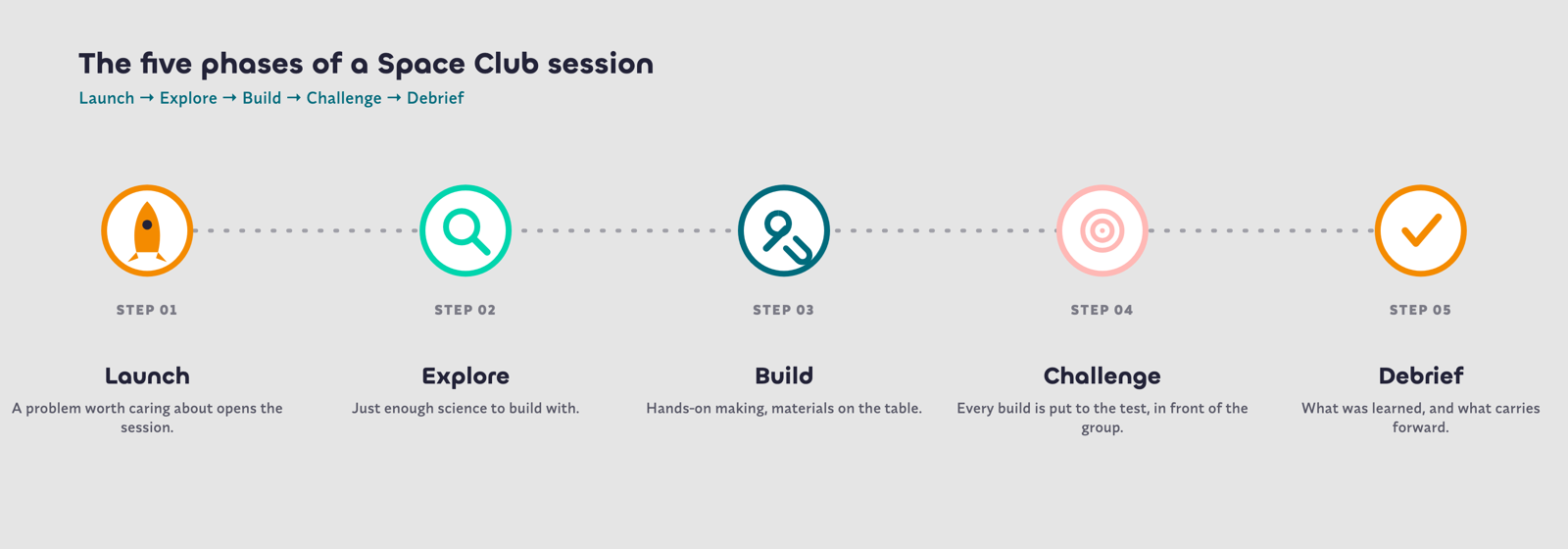
Space Club is our weekly after-school club for KS2 children, Years 3 to 6, and every session follows the same five phases we use to structure real engineering thinking into something a nine-year-old can do with their hands. Launch opens the session with a problem worth caring about, a hook, in the same way a design review opens with the question we’re actually trying to answer. Explore gives children just enough science to build with, mirroring the research and reading that comes before any real design starts. Build is hands-on, materials on the table, the same iterative making-and-checking that fills most of my working week. Challenge puts every build to the test in front of the whole group, which is a gentler version of the vibration table, but the same principle: you find out, in public, whether it really works. Debrief asks what was learned and what carries forward, which is exactly the conversation my team has after every test, successful or not.
A child who has sat through a Launch to Debrief cycle a few dozen times over a school year has practised solving a problem they didn’t start out knowing how to solve, has had to get creative when the first attempt didn’t work, has had to work with people whose ideas were different from their own, and has had to explain what they built and why. Those are the same four skills that got my team through a failed test on the way to the Moon. I don’t think that’s a coincidence. I think it’s the whole point.
What to do next
If you’re a teacher reading this and wondering whether your pupils would respond to that kind of structure, the simplest way to find out is to see it in the room. See it in your hall before you decide anything. We offer The Journey Up, a free 45 minute assembly for the whole school, covering the same engineering story in this post. To book a date, email [email protected] or call 07873 621402.
If you’re a parent wondering whether your child would enjoy building, testing and explaining their own missions every week after school, Space Club is where that happens. It runs weekly after school for KS2 children, Years 3 to 6, built around the same five-phase mission structure described above. To ask about a space at your child’s school, or to find out which schools currently run it, email [email protected] or call 07873 621402.

Mirko Viviano
Founder of Louno Space Education CIC. Runs space-themed STEAM clubs, workshops and assemblies in primary schools across the UK.
Bring real space engineering into class
Hands-on space workshops for science weeks and topic launches, with all kit included.