How to start a science club at a primary school comes down to five things: a room and a slot, a way to pay for it, a safe adult to run it, a plan for the first six sessions, and a register. Everything else, from the name to the badges, can come later. Here is the order to do it in, what each step really costs in time, and where schools usually get stuck.
We start clubs in primary schools for a living and most of ours began with a teacher or a parent asking this exact question. This is the advice we give them, whether they end up running it themselves or asking us to.
1. Find the slot and the room
After school from about 3.15 to 4.15 is the normal slot; lunchtime works for KS2 if you accept a shorter session and children arriving with sandwiches. The room needs table space, a sink nearby, somewhere to store a box, and a floor you are allowed to drop things on. A classroom is fine. A hall is better for anything that flies.
Agree the slot with the office before anything else, because the slot decides which year groups can come and whether siblings can be collected together.
2. Decide who pays
There are three honest models and schools mix them.
- The school funds it from an enrichment or PE and sport premium-style budget. Simplest for parents, hardest to sustain when budgets move.
- Parents pay termly. Most common for externally run clubs. It needs a booking system, a refund policy and a clear answer for the family who cannot pay.
- The PTA or a local sponsor covers it. Good for kit and start-up costs; less reliable for staffing week after week.
Whatever the model, decide up front what happens for children whose families cannot pay. A club that only the confident half of the class can afford reinforces exactly the gap a science club should close. Our answer is subsidised places every term, funded because we are a Community Interest Company; a school-run club can do the same with a small pot from the PTA.

3. Find the adult, and do the paperwork before session one
Whoever runs the club needs an enhanced DBS check, safeguarding training to the school’s standard, and a named member of staff on site. If the adult is a teacher, that is done. If it is a parent volunteer or an external provider, it must be done and in the office before the first child walks in, not after.
Add a risk assessment for the activities (anything with heat, pressure, drops or small parts), public liability insurance if the provider is external, and a one-page behaviour and collection policy. It sounds like a lot. It is an afternoon, and it is the afternoon that lets the head say yes.
4. Plan six sessions, not a year
A first term of six to nine sessions is enough to find out whether the club works. Plan them all before you start, to the same shape each week so children know what is coming. Ours is Launch, Explore, Build, Challenge, Debrief: a hook, just enough science, a build, a test in front of everyone, and a minute on what was learned.
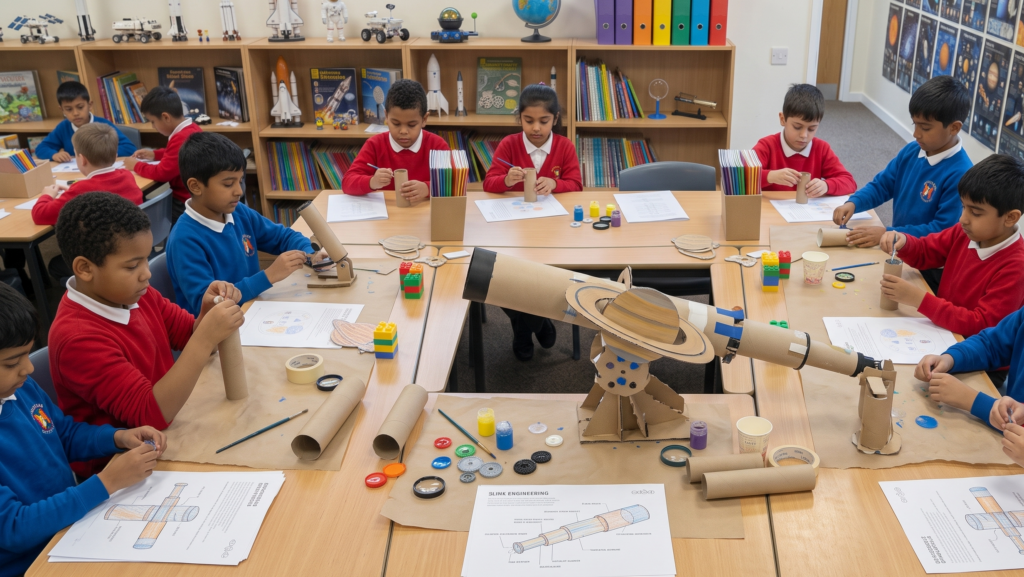
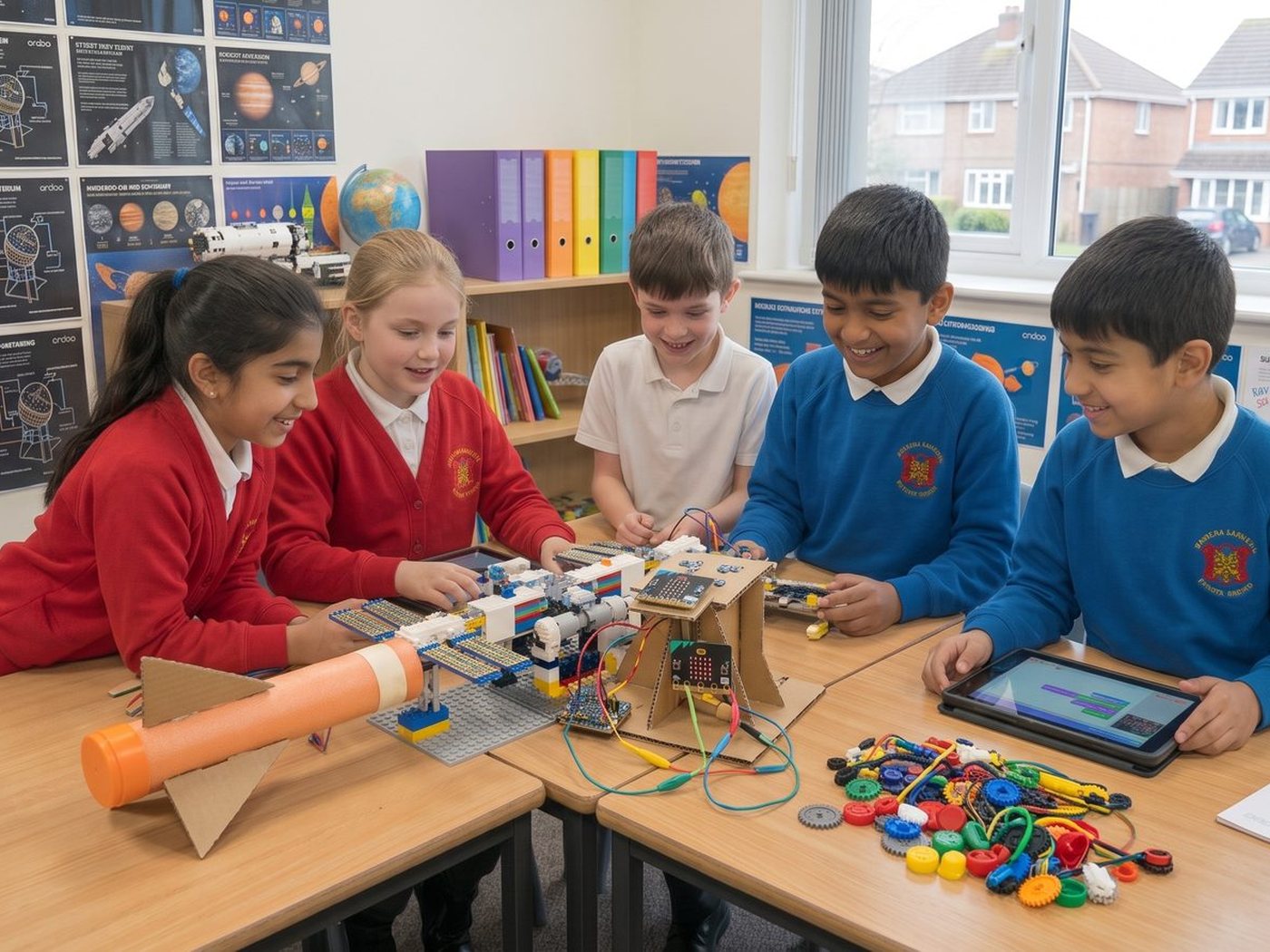
Pick builds that fail usefully. An egg lander dropped from a chair. A paper rocket with and without fins. A circuit that does not light until the fault is found. A “Moon crater” made by dropping a marble into flour and cocoa, then changing one variable and dropping it again. Each one fits a classroom, costs almost nothing, and links to the curriculum: forces and materials in KS1 and KS2, electricity in Years 4 and 6, Earth and Space in Year 5.
Write a floor and a ceiling into each session: what the least confident child will finish, and what the fastest pair can push on to. It is the single biggest difference between a club that holds a mixed group and one that loses both ends.
5. Launch it with an event, not a letter
A letter home gets the children who were already going to come. An assembly gets the rest. A twenty-minute whole-school session where something visibly flies, breaks or lights up, followed by a short note to parents, fills a club in a week. This is how our clubs start: a free 45-minute whole-school assembly, a 15-minute conversation with the school to agree the day, time and price, a 2-minute survey for families on those terms, and if enough families want it, the club starts the following term.
6. Run the first term, then decide
Keep a register, take photos (with consent) of builds and tests, and write three lines after each session: what worked, what did not, who surprised you. At the end of term you have the evidence the head, the governors and the parents will ask for, and you know whether to carry on.
End the term with something. A graduation, a badge, a showcase where the crew presents a build to their parents. A club that ends with “see you next term” loses half its members over the holiday; one that ends with a certificate keeps them.
What it honestly costs in time
For a teacher running it alone: about two hours of planning per session in the first term, one hour of delivery, thirty minutes of set-up and clear-up, plus the admin of a register and parent messages. Call it four hours a week on top of the day job, which is why most teacher-run clubs last a term or two and then stop. That is not a failure of enthusiasm. It is arithmetic.
The ways around it are to share the load between two staff, to run it for a fixed term with a clear end, or to bring in a provider who arrives with everything and leaves with everything, so the school provides the room and a register and nothing else. That last one is what we do, and we say so plainly because it is the reason schools call us.
The checklist
- Slot and room agreed with the office
- Funding model chosen, and a plan for families who cannot pay
- Enhanced DBS, safeguarding training, risk assessment and insurance in the office before session one
- Six sessions planned to one shape, each with a floor and a ceiling
- A launch assembly and a one-paragraph note to parents
- Register, photo consent, three lines after every session
- Something to mark the end of term
If you would rather we started it
The Space Club is the version of all of the above that arrives fully staffed: a trained, DBS-checked Mission Specialist every week, a library of more than a hundred curriculum-mapped missions, every material brought in and taken away, parent communications handled, and a termly impact report for governors and inspections. It begins with the free assembly, costs the school nothing to start, and from first contact to first session typically takes two to four weeks. For what a good club should look like once it is running, see what is a STEM club.
Questions teachers ask
How many children should a primary science club have?
Twelve to sixteen for one adult running a build. More than that, add a second adult or split the club by key stage.
How long should a session be?
An hour after school. Forty-five minutes at lunchtime. Shorter than that and the build does not get tested.
Can a parent run a school science club?
Yes, with an enhanced DBS check, safeguarding training and a member of staff on site. Many clubs start that way. The difficulty is sustaining it past a term, which is where a written plan and a second adult make the difference.

Mirko Viviano
Founder of Louno Space Education CIC. Runs space-themed STEAM clubs, workshops and assemblies in primary schools across the UK.