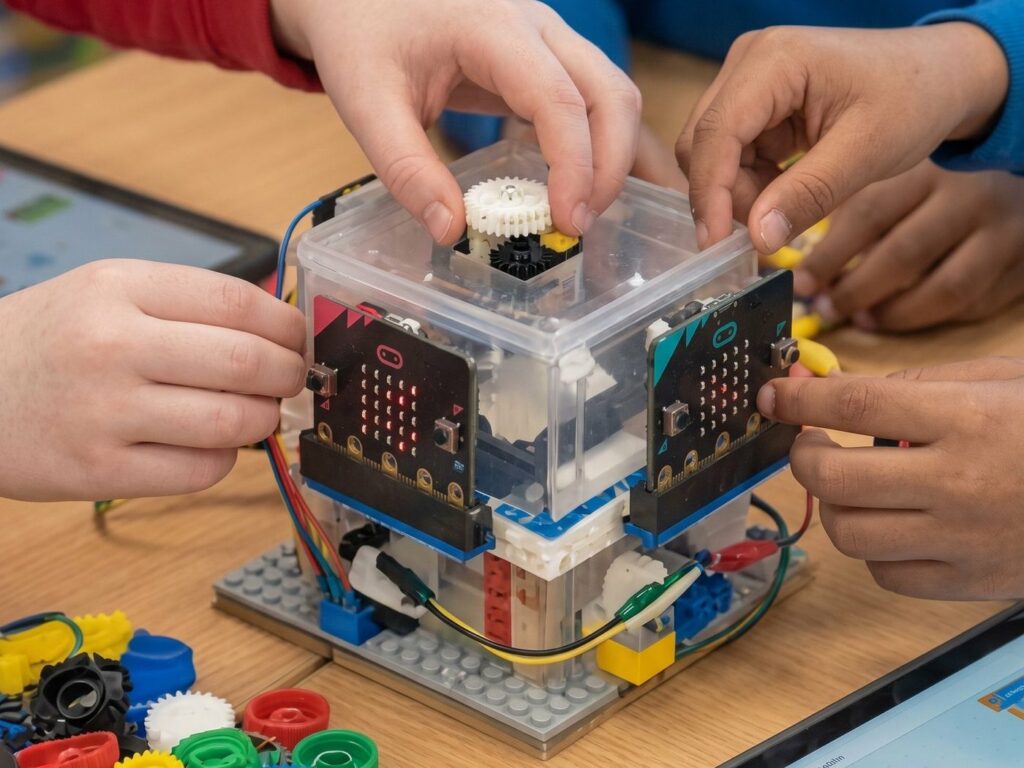
Improving STEM provision in a primary school starts with three steps: find out what pupils experience now, add one STEM moment that reaches every child, and build one regular activity that children can join each week. From there, a school can build towards curriculum-linked workshops, links with people who work in STEM careers and, for many schools, a quality mark that recognises the work. This guide sets out a one-year plan for a school starting from little or no STEM enrichment.
It is written by space engineers who run assemblies, workshops and after-school clubs in primary schools.
Start with an honest audit
Before adding anything, take stock. A short audit in the first few weeks gives you a baseline, and a baseline is what turns activity into evidence later on.
- What happens now? List every science, technology, engineering and maths activity beyond normal lessons: clubs, visits, visitors, competitions, themed weeks.
- Who takes part? Note which year groups and which pupils join in. Gaps for pupils eligible for pupil premium matter most.
- What do pupils think? Ask a few children from each class what they enjoy in science and whether they know anyone who works in STEM.
- Who can help? Note staff with an interest in STEM, parents who work in STEM jobs and any local employers or universities.
Keep the audit short. A one-page summary is enough to plan from and to compare against at the end of the year.
Free download: our STEM enrichment self-audit turns this audit into a 20-minute exercise, scored against the eight DfE enrichment benchmarks.
A one-year plan for better STEM provision
| Term | Focus | Example actions |
|---|---|---|
| Autumn | Reach every child | A whole-school STEM assembly, a STEM Ambassador visit, one STEM afternoon per class |
| Spring | Build something regular | A weekly STEM club, a British Science Week plan, curriculum-linked workshops |
| Summer | Show the impact | A family showcase, pupil voice repeated, careers week, evidence pulled together |
Autumn: reach every child
Start with something that involves the whole school, so no child’s experience of STEM depends on joining a club. A whole-school assembly from a visiting engineer or scientist is the quickest way to do this. Follow it with one hands-on STEM afternoon per class, such as a rocket or bridge-building challenge.
STEM Ambassadors are a strong early step. They are volunteers who work in STEM jobs and visit schools through STEM Learning’s national programme, and they can give talks, help with clubs and judge challenges.
Spring: build something regular
One-off events create excitement. A weekly club is what builds skills. A STEM club can be run by a member of staff or by an external provider, and either way it should be hands-on every week, with children designing, building, testing and improving. Our guide on how to start an after-school science club covers the practical steps.
Spring is also the time to plan British Science Week in March (our STEM assembly ideas give you a whole-school launch) and to book workshops that link to the units classes are studying, such as forces in Year 3 and Year 5 or Earth and space in Year 5.
Summer: show the impact
End the year with something families can see: a showcase where children present what they built and what they learned. Repeat the pupil voice questions from the autumn audit, so you can show how attitudes have changed. Then gather your evidence in one place.

A quick win for this term
Book The Journey Up, a free whole-school space assembly led by a spacecraft engineer.
What counts as evidence
Whether the goal is a quality mark, a governors’ report or the school development plan, the same evidence helps:
- Participation: who took part in each activity, by year group and by pupil group.
- Pupil voice: children’s own words about STEM, collected at the start and end of the year.
- Skills: progress in skills such as problem solving, teamwork and communication.
- Work: photos of builds and investigations, with children’s faces hidden where your policy requires it.
- Partnerships: every external visitor, workshop and partner, with what they added.
- Families: how parents were involved, from showcases to take-home challenges.
Quality marks and frameworks to aim for
Several recognised schemes give a school a structure and a goal. Each has its own criteria, so check the scheme’s own materials before you start.
- The Primary Science Quality Mark (PSQM) is a year-long programme for science leadership in primary schools, run by the University of Hertfordshire.
- The STEM Clubs Quality Mark from STEM Learning recognises clubs that enrich the STEM curriculum.
- The Department for Education’s Enrichment Framework, published in June 2026, gives eight benchmarks for a school’s whole enrichment offer, with STEM part of its “wider life and future skills” category. Our guide to the Enrichment Framework explains each benchmark.
A good STEM enrichment programme feeds all three: it reaches pupils, builds skills, brings in partners and produces evidence.
Paying for STEM enrichment
- Free options: STEM Ambassadors, free assemblies from providers, and free resources from STEM Learning.
- Parent-funded clubs: an external provider can run an after-school club funded by the families who book it, with the school providing a room.
- Pupil premium: the “wider strategies” part of a school’s pupil premium strategy can cover barriers such as attendance and wellbeing. Check your own strategy and the latest DfE guidance before using it for enrichment.
- Local grants and sponsors: local employers, especially in engineering and technology, often support school STEM activities.
How Louno Space helps schools build STEM provision
Louno Space works with primary schools that want to start or grow their STEM offer:
- The Journey Up, a free whole-school space assembly led by a practising spacecraft engineer, which reaches every pupil from Reception to Year 6 in 45 minutes.
- A weekly Space Club for KS2, funded by the families who book it, with hands-on engineering challenges and eight skills tracked through the year.
- Class workshops for science weeks and topic launches.
- Evidence for your records: participation, skills progress and family feedback that a school can use in its own reporting.
The assembly is the usual first step. After it, we send families a short survey, and a club starts where families want one.
Questions schools ask about STEM provision
What is STEM provision in a primary school?
Everything a school offers in science, technology, engineering and maths beyond the core lessons: clubs, visits, visitors, workshops, competitions and themed weeks.
How can a school improve STEM with no budget?
Start with free options: a STEM Ambassador visit, a free assembly from a provider and free resources from STEM Learning. A parent-funded after-school club run by an external provider adds a weekly activity at no cost to the school.
How long does it take to build good STEM provision?
A school can reach every pupil within a term and have a weekly club running by the spring. A full year gives enough time to show impact and gather evidence.
Does STEM provision help with a quality mark?
Quality marks such as the Primary Science Quality Mark and the STEM Clubs Quality Mark each have their own criteria. Well-planned STEM enrichment, with participation data, pupil voice and partnerships recorded, gives a school evidence it can draw on. Check the scheme’s own criteria for what it needs.
What is the easiest first step?
A whole-school STEM assembly. It reaches every child in one session, costs little or nothing, and shows quickly how much interest there is for a club.

Mirko Viviano
Founder of Louno Space Education CIC. Runs space-themed STEAM clubs, workshops and assemblies in primary schools across the UK.
Add a weekly STEM club
Space Club runs after school for KS2, with tutors and every bit of kit provided by our team.