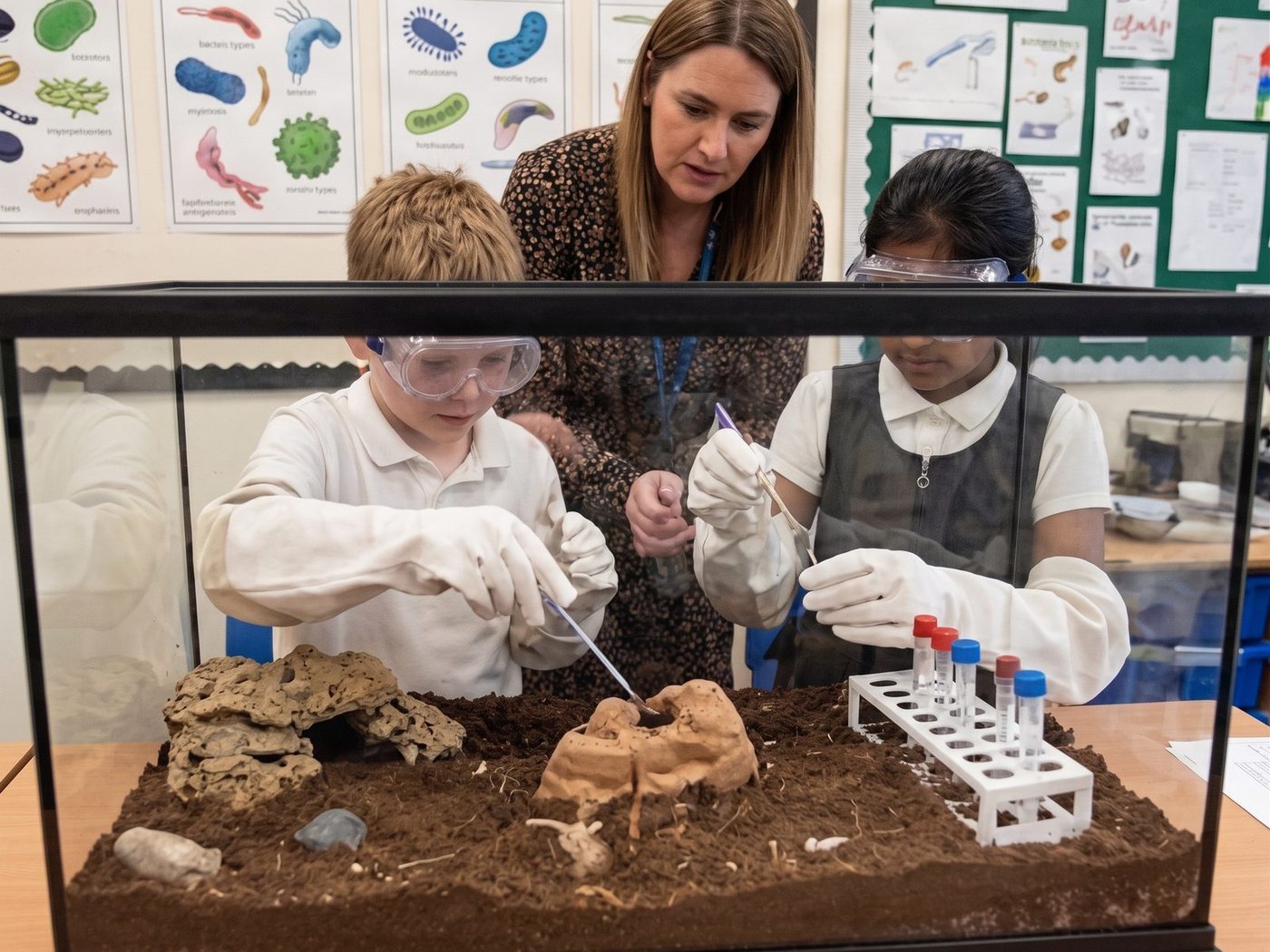
What does space teach us? Not the facts, mostly. Children can find the temperature of Neptune in four seconds. What space teaches, when it is taught with hands rather than slides, is how to ask a question nobody in the room can answer, how to be wrong in front of everyone, and how to try again. We run space sessions in primary schools every week, and those three habits are what we are actually there for.
This article is for the teacher or parent who has a child hooked on space and wants to know what to do with that. Here is what the subject is good for, why it works better than almost any other hook we know, and how to put it to work in a classroom or a kitchen.
It teaches children to ask questions nobody can answer
Most school science has an answer at the back of the book. Space has real open questions, and children can tell the difference. Is there life anywhere else? What is inside a black hole? Could people ever live on Mars? When we put one of those to a school hall and ask for a vote, the room splits, the arguments start, and the quiet child at the side has an opinion for once, because there is no wrong one yet.
That matters more than it sounds. A child who has argued about an open question has practised forming a view, listening to a better one, and changing their mind. Those are the habits scientists use every day, and they transfer to everything else.
It teaches them to be wrong in public, and to recover
Every mission we run ends with a test in front of the whole crew. The lander drops and the egg breaks. The rocket without fins tumbles into the wall. The satellite design goes over its mass budget and something has to come off. The first attempt failing is not a problem with the session; it is the session.
Space gives you failure with a story attached. Real missions fail, are rebuilt and fly again, and children accept that because the stakes are a cardboard lander rather than a spelling test. By the third week the phrase we hear most is “can we try it again?”, which is the whole of engineering in four words.
It teaches that everything has a cost
Nothing goes to space for free. Every gram has to be lifted, every watt has to come from somewhere, and every kilogram of water is a kilogram of something else left behind. Give a group of nine year olds a satellite to design with a mass budget that does not quite stretch, and they learn what a trade-off is in forty minutes, from the inside. We have watched children who struggle with subtraction on a worksheet do it fluently when the numbers are on the parts of their own satellite.
It teaches that the team is the unit
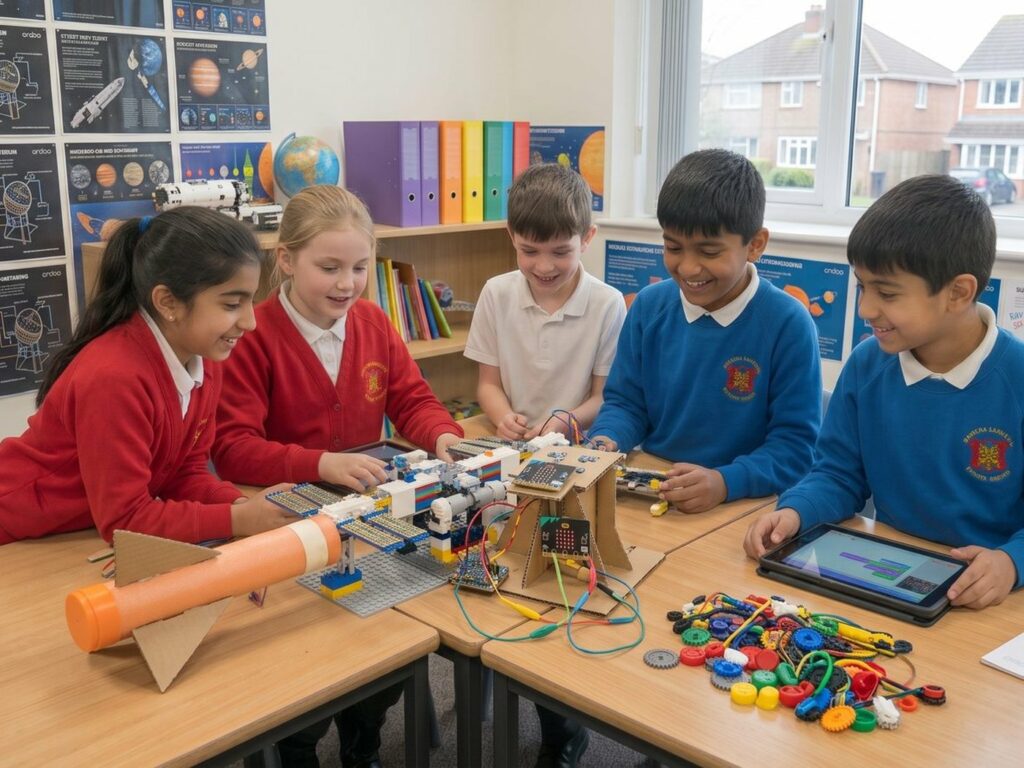
No spacecraft was ever built by one person. A mission needs someone who builds, someone who checks, someone who explains the result and someone who notices what everybody else missed. When children work as a crew, with named roles, the child who would never volunteer to present turns out to be the one who spots the fault in the circuit. Space gives you a reason to put children in teams that is not “because I said so”.
It teaches who gets to be a scientist
Ask a class to draw a scientist and you learn what they have already decided about themselves. Space is one of the few subjects where the stories of the people who do the work are as interesting as the work, and where the cast is wider than children expect: the engineers, coders, artists and planners who get a mission off the ground. In our assemblies we show them on purpose. A child who sees someone like themselves building a satellite stops thinking of science as something other people do.
How to put it to work
None of this needs a planetarium. It needs a question, a build and a test, in that order, and the discipline not to skip to the answer.
- Start with one open question a week. Could we live on Mars? Where does space begin? Why can’t we stand on Uranus? Vote, argue, then go and find out what is known.
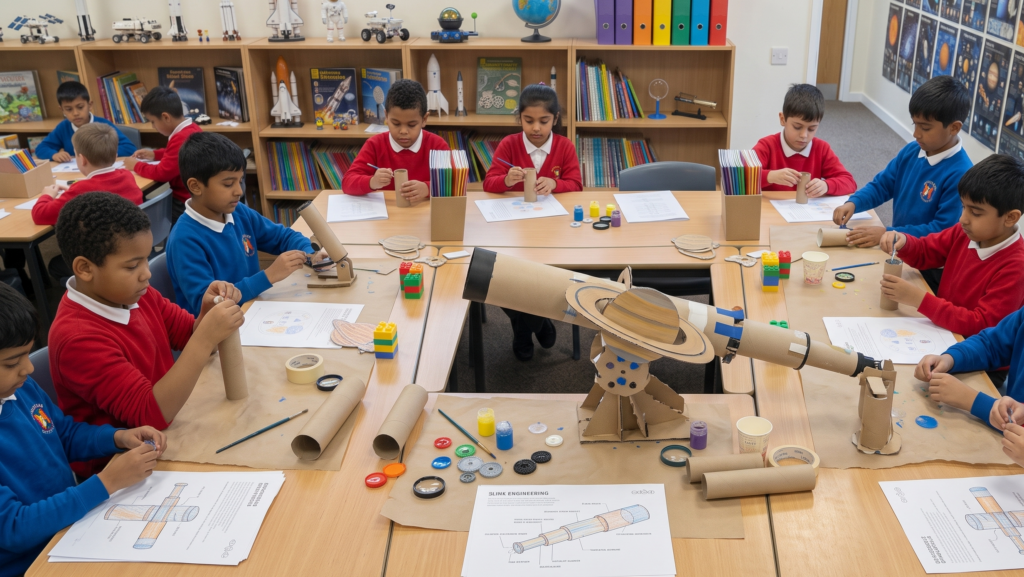
- Build something that can fail. A lander for an egg, a paper rocket, a Moon crater in a tray of flour. If it works first time, the test was too easy. Raise the drop.
- Test it in front of everyone. The audience is the point. Children take a test seriously when the crew is watching and take the redesign seriously when the crew has seen the failure.
- Name what they practised. “That was persevering.” “That was adapting.” Children do not notice a skill unless somebody says it out loud, so we do, at the end of every session.
- Keep a mission log. One page a week: the question, the build, the result, one thing to change. It is evidence for the school and a record the child can see themselves improving in.
What we do with it
Everything above is built into the Space Club, our weekly after-school club in primary schools: a different mission every week, a five-phase session that always ends with a test, and eight named skills called out in the debrief. Schools usually start with a free whole-school assembly, where the open question is put to the whole hall and somebody in the front row ends up holding a piece of a real satellite. That assembly is where most of our clubs began, and it costs the school nothing.

Mirko Viviano
Founder of Louno Space Education CIC. Runs space-themed STEAM clubs, workshops and assemblies in primary schools across the UK.