Good space party games need almost no kit, work in a living room, and fit inside a story about a crew on a mission. These twelve are the ones we run at our own parties for four- to nine-year-olds, in the order that keeps the energy where you want it: a burst, a build, a burst, a calm finish.
For each game, you get the kit, the time it takes, how to run it, and the one thing children are learning while they think they are just playing. Pick five or six, not all twelve.
Arrival games: burn off the first ten minutes
1. Mission Commander Says
Kit: none. Time: 5 minutes. Simon Says with the birthday child in charge and space orders: “Commander says float”, “Commander says put on your helmet”, “Commander says check your oxygen”. Anyone who moves without the command is back on Earth. It hands the room to the birthday child in the first five minutes, which sets up the whole afternoon. Learning: listening, and the idea that astronauts follow checklists for a reason.
2. Moon-walk race
Kit: cushions, a start and a finish. Time: 5 minutes. Cross the room in slow motion, the way the Apollo crews bounced, without touching the floor between cushions. Fastest slow-walker wins, which is a contradiction children love. Learning: gravity on the Moon is about a sixth of Earth’s, which is why the astronauts hopped.
3. Asteroid dodge
Kit: soft balls or rolled socks. Time: 5 minutes. Two adults roll “asteroids” slowly across the floor while the crew crosses the asteroid belt. If you’re hit, you wait one turn at the space station. Rolled, not thrown, keeps it safe for the smallest. Learning: the asteroid belt is mostly space; real probes fly through it without dodging anything, which surprises every child who hears it.
The build: hands busy, voices down
4. Straw rocket range
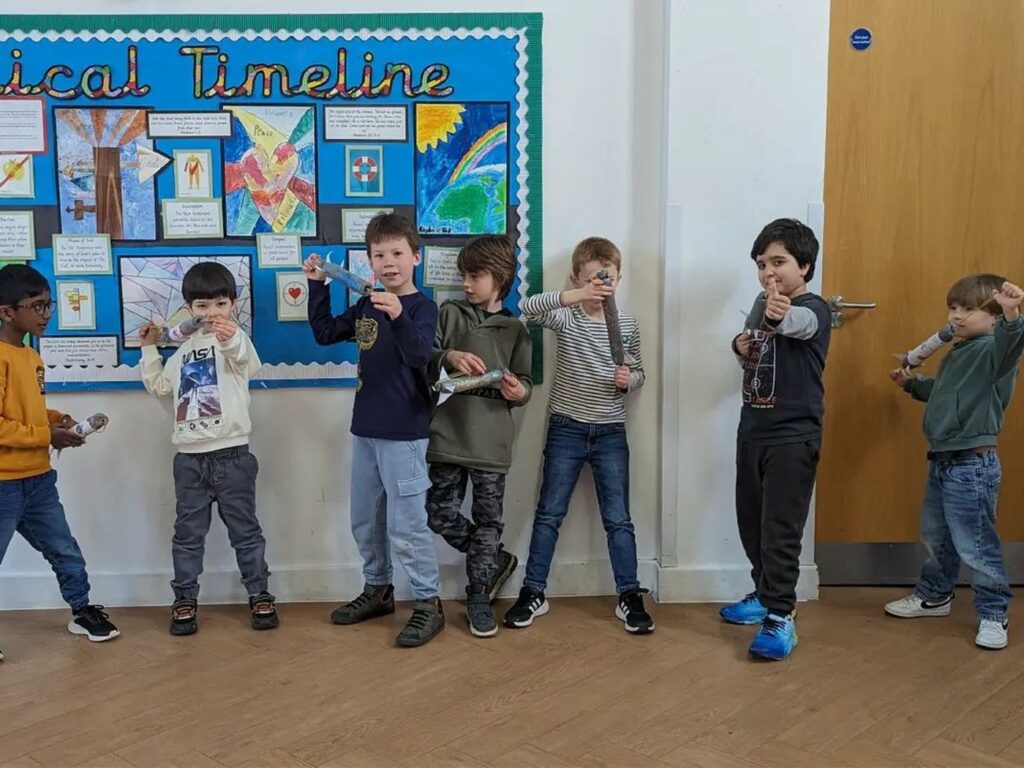
Kit: paper, tape, card, pencils, drinking straws, a target on the wall. Time: 20 minutes to build, 10 to fly. Each child rolls a paper tube around a pencil, seals one end, adds a nose cone and fins, then fires it from a straw. Score by distance or by target rings. Let them change one thing (fins on or off, longer or shorter) and fly again. Learning: fins keep a rocket straight; a rocket without them tumbles, and they will have seen both.
5. Tallest launch tower
For ages 7 and up
Kit: dry spaghetti, marshmallows, a tape measure. Time: 15 minutes. Teams of three build the tallest tower that will hold a paper rocket on top for ten seconds. Triangles win, every time, and someone works that out about eight minutes in. Learning: why engineers love triangles, and that the first design is never the last one.
6. Paper-plate planet workshop
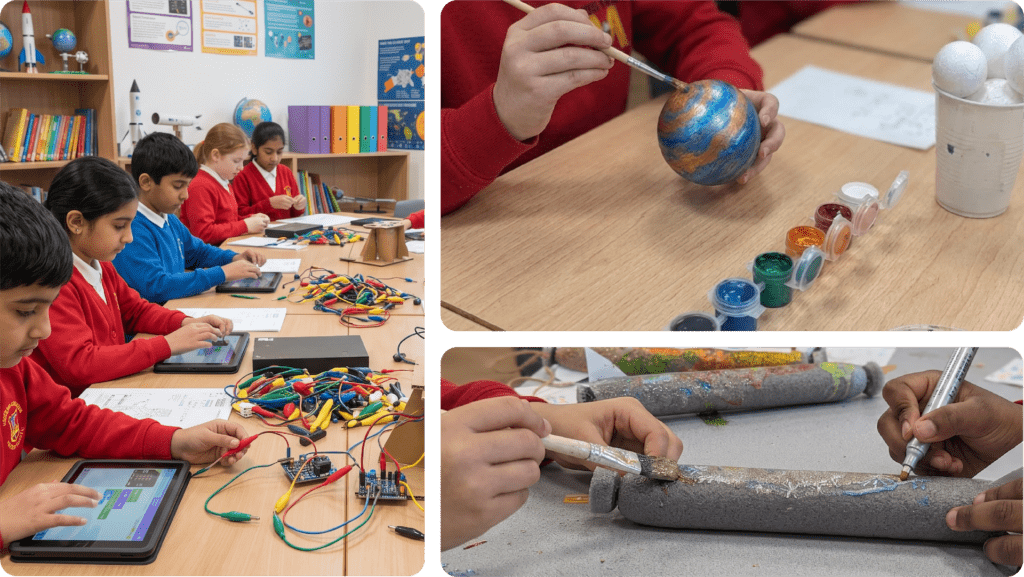
Kit: paper plates, paint, string, printed fact cards. Time: 20 minutes. One planet per child, painted from a fact card, hung in order on a line across the room. Gives you the set for game 9. Learning: the order of the planets and one fact each, chosen by the child who painted it, which is how facts stick.
Mission games: the loud middle
7. Astronaut training course
Kit: oven gloves, a jar with a lid, a shoelace, a sealed bag of sweets. Time: 10 minutes. Wearing oven gloves (spacesuit gloves), each child has to open the jar, tie the lace and open the bag. Time them. It is much harder than it looks and very funny to watch. Learning: spacesuit gloves are pressurised and stiff, and astronauts train for months to do simple jobs in them.
8. Gravity guess
Kit: a tennis ball and a table-tennis ball, or any heavy and light pair that will not break. Time: 5 minutes. Everyone votes on which lands first when dropped together from the same height. Drop them. They land together. Do it three times because nobody believes it the first time. Learning: Galileo’s experiment, and the reason a hammer and a feather landed together when an Apollo astronaut tried it on the Moon.
9. Planet order relay
Kit: the painted plates from game 6, or eight cards with planet names. Time: 10 minutes. Shuffle the planets, split into two teams, and race to line them up from the Sun outwards. Then do it again with the teams swapped, against the clock. Learning: Mercury, Venus, Earth, Mars, Jupiter, Saturn, Uranus, Neptune, learned with their feet.
10. Alien message hunt
Kit: a printed symbol cypher, three short coded messages hidden around the room. Time: 15 minutes. The crew decodes the first message, which tells them where the second is, and the last one says where the cake is. Younger children work in pairs with a reader. Learning: codes and patterns, and the real idea behind it: we listen for signals from space with radio telescopes, and so far the universe has been very quiet.
Landing games: bring it down gently
11. Constellation freeze
Kit: music. Time: 5 minutes. Musical statues, but when the music stops, the caller names a shape (the Plough, a rocket, Orion’s belt) and the crew has to make it together in a frozen pose. Nobody is out; the game is whether they can all agree on the shape in five seconds. Learning: constellations are patterns people agreed on, not real groups of stars.
12. Countdown launch
Kit: a stomp rocket or a bottle rocket, a garden or park, a line on the ground. Time: 10 minutes. The finale. Everyone behind the line, one adult on the launcher, the Mission Commander leads the countdown from ten. One launch per child if the kit allows; one big shared launch if it does not. Never indoors, and never with anyone in front of the line. Learning: action and reaction, which you can say out loud once and then let the rocket explain.
How to order them
Think in energy, not in time. Two arrival games while the last guests turn up. One long build while everyone is fresh. Two or three mission games to let the noise out. One landing game and the launch to finish, then food, certificates and cake. For four- and five-year-olds, drop the build to ten minutes of decorating and double the moving-about games. For eight- and nine-year-olds, make the build a design challenge with a scoreboard, and give the tower game (number 5) a second round.
If you want the full shape of the afternoon, our space birthday party ideas guide covers themes, food, invites and the mistakes to avoid.
Or let a space engineer run the games
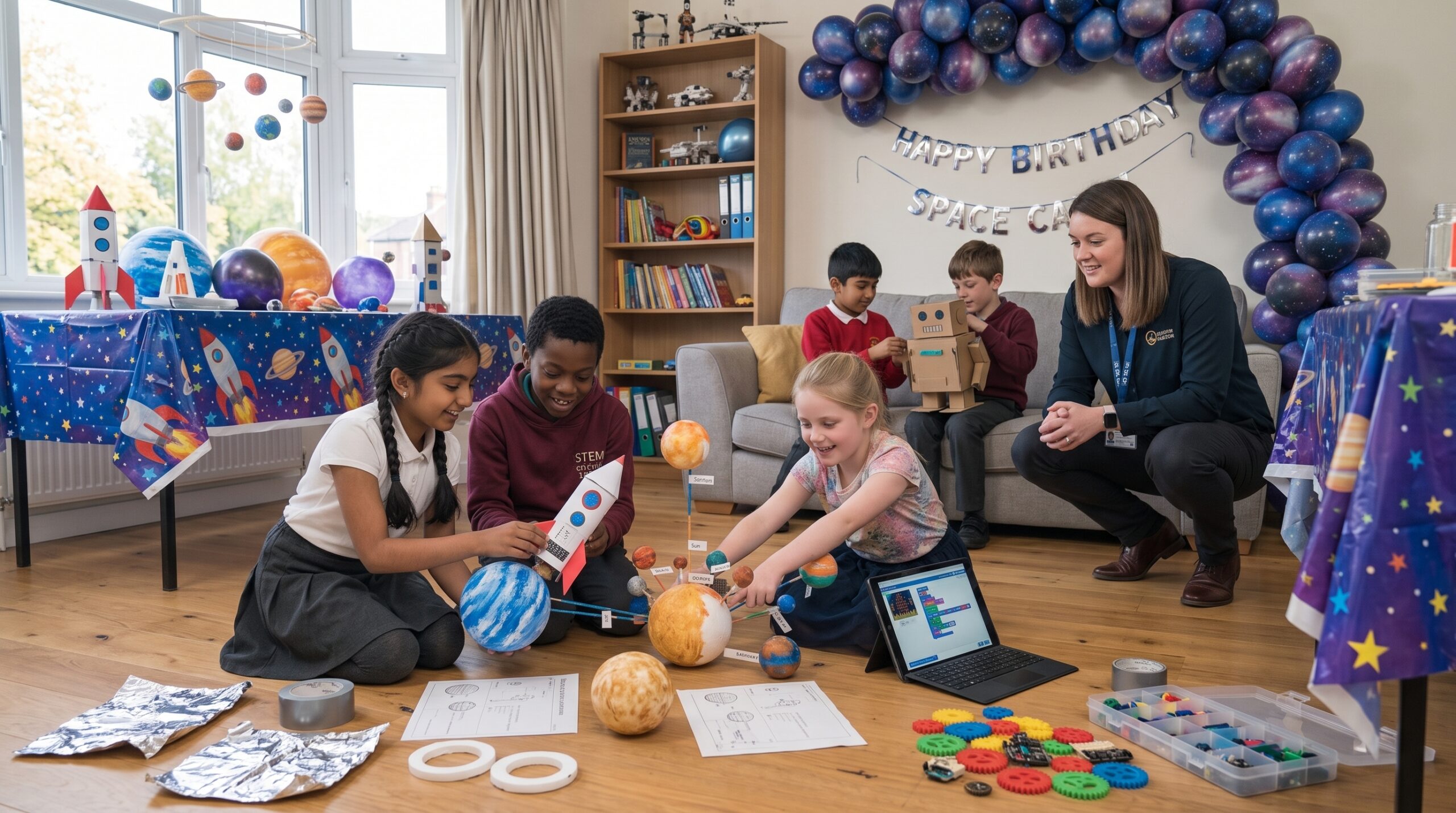
Every game above comes from our own space birthday parties, which are run at your home or venue by a real space engineer who brings the rockets, the kit, the invitations and the certificates, and takes the launch outside. Ninety minutes, ages six to eleven, £180 for up to ten children. You bring the cake and the crew.

Mirko Viviano
Founder of Louno Space Education CIC. Runs space-themed STEAM clubs, workshops and assemblies in primary schools across the UK.